How Does Build Plate Design Affect Metal 3D Printing?
The Build Plate Provides the Foundation for Metal 3D Printing
In metal 3D printing, build plate design directly controls conductive heat dissipation, first-layer weld fusion, and mechanical restraint against severe thermal warping. Far from serving as a passive mechanical stage, the substrate functions as an active thermal heatsink and structural anchor.
An inadequate plate design causes localized overheating, poor first-layer fusion, or catastrophic delamination during laser exposure.
Build Plate Material Affects Heat Transfer
Substrate metallurgy dictates how quickly molten pool energy conducts downward away from solidified layers. Selecting a substrate with mismatched thermal expansion or poor thermal conductivity creates unstable localized melt pools.
| Substrate Alloy | Typical Thermal Conductivity | Thermal Compatibility Target | Primary Operational Risk |
| Forged Tool Steel | $\approx 25\text{–}35\,\text{W/(m}\cdot\text{K)}$ | Carbon and stainless steels | High interface stress with reactive alloys |
| Titanium Gr. 5 | $\approx 7\text{–}8\,\text{W/(m}\cdot\text{K)}$ | Ti6Al4V, Ti6Al4V ELI | Heat retention causing surface over-melting |
| Aluminum 6061 | $\approx 150\text{–}170\,\text{W/(m}\cdot\text{K)}$ | AlSi10Mg, Scalmalloy | Rapid heat sink causing fusion lack at root |
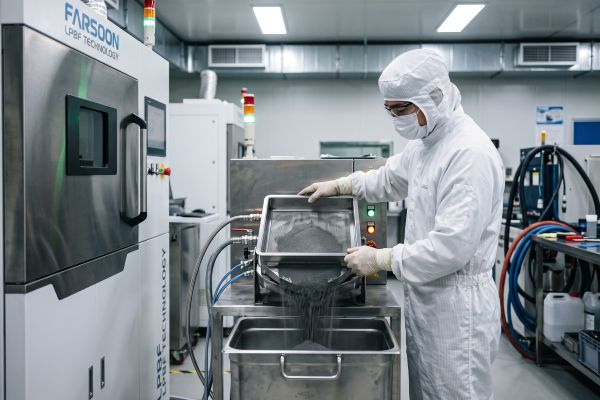
Matching the substrate alloy to the powder prevents dissimilar-metal contamination when recycling residual batch powder from a metal 3D printer.
Surface Condition Influences First-Layer Adhesion
Reliable consolidation begins with consistent root-layer anchoring. Substrate plates require uniform surface ground flatness ($\le 0.05\,\text{mm}$ across the diagonal) to maintain a steady powder gap during initial recoater travel.
- Surface Texture: Plates are typically grit-blasted to an average roughness of $Ra \approx 3.2\text{–}6.3\,\mu\text{m}$. This texture gives loose powder particles mechanical interlocking points when the laser initiates the initial weld pass.
- Oxide Film Control: Residual oxidation on the substrate surface interferes with clean metallurgical wetting. Operators must solvent-wipe and lightly abrade reused plates to eliminate contamination.
If the first layer fails to bond securely, recoater blade friction will dislodge delicate support pillars, ruining the build.
Build Plate Thickness Affects Thermal Stability
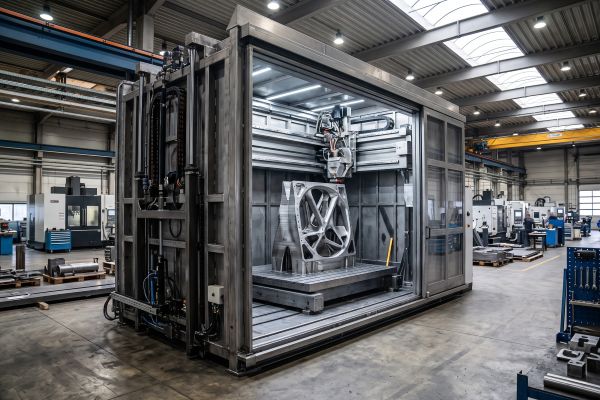
Substrate thickness dictates mechanical rigidity under intense thermal cycling. As thousands of molten tracks solidify and contract, they exert immense tensile forces pulling upward at the plate corners.
Thin substrates ($<15\,\text{mm}$) frequently bow upward under high residual stresses. This warping disrupts the precise leveling of the powder bed, causing the recoater to collide with protruding parts. Heavy production plates ($25\text{–}50\,\text{mm}$) resist deflection during extended 100-hour production cycles on commercial metal 3D printers. Thicker masses also stabilize internal heat distribution from resistive bottom heaters.
Balancing Mechanical Restraint and Part Removal Efficiency
Substrate design must balance part retention against post-build separation efficiency. Parts must remain anchored during laser scanning, yet release cleanly without damaging the component base.
- Direct Bolt Mounts: Heavy perimeter bolt patterns hold the substrate down against lifting forces, but they require lengthy manual setup between production cycles.
- Zero-Point Clamping: Pneumatic quick-change receivers secure the plate with high repeatability, allowing rapid swapping in continuous production.
- Subtractive Cutoff Clearances: Plates intended for separation via wire EDM cutoff require dedicated peripheral clearance paths and wire lead-in grooves to avoid slicing through clamping pins.
Optimizing mounting geometry cuts turnaround downtime between successive machine runs.
Matching Substrate Architecture to Alloy Demands
Demanding alloy systems require customized plate architecture. Refractory metals and crack-susceptible tool steels require integrated cartridge heaters reaching $200^\circ\text{C}\text{–}500^\circ\text{C}$ directly beneath the plate surface.
Conversely, compact medical implants printed on a specialized metal 3D printer run on modular, segmented pin-plates. These segmented plates isolate individual parts, allowing technicians to saw individual components off without clearing the entire platform. Evaluating application geometry dictates whether you install a heavy monolithic slab or a modular segmented system.
Evaluating Substrate Systems When Selecting a Metal 3D Printer
Reviewing build plate architecture reveals a machine’s true production readiness. Buyers should inspect plate leveling mechanisms, integrated preheating arrays, and clamping repeatability rather than focusing solely on laser wattage.
A high-performance metal 3D printer maintains flat substrate positioning and uniform heat distribution across every build. Selecting a system with robust substrate engineering ensures predictable quality and minimal scrap across challenging alloy jobs.
Contact our engineering team today to review your production files and determine the optimal substrate configurations for your target components.