What Types of Metals Can a Metal 3D Printer Process?
Metal 3D Printers Can Process Different Metal Families
An industrial metal 3D printer processes five primary alloy families: stainless steels, titanium alloys, aluminum alloys, nickel superalloys, and refractory or precious metals like pure copper. However, material compatibility varies significantly across machines. Weldability, powder flowability, and optical absorption dictate whether a specific alloy runs reliably on a given platform.
Processing diverse metal powders requires matching machine hardware to distinct physical properties. You cannot melt reactive titanium and reflective copper using identical laser and environmental configurations.
Stainless Steel Is Widely Used for Industrial Parts
Stainless steel serves as the foundational material baseline across commercial metal 3D printers. Grades like 316L and 17-4 PH provide dependable mechanical properties, excellent corrosion resistance, and wide processing latitude.
Austenitic 316L absorbs standard near-infrared fiber lasers efficiently. It delivers high ductility and dense microstructures suitable for chemical manifolds, food-processing equipment, and marine components. Precipitation-hardening 17-4 PH provides superior yield strength and hardness after direct post-build heat treatment. Its predictable consolidation makes it a staple for functional prototyping and production tooling.
Aluminum Alloys Offer Low Weight and Good Processability
Aluminum alloys reduce structural mass in automotive and aerospace assemblies. Common formulations include AlSi10Mg and Scalmalloy.
Aluminum presents distinct physical challenges compared to ferrous alloys. Its high thermal conductivity rapidly dissipates laser energy away from the melt zone. Additionally, fine aluminum powder exhibits lower bulk flowability, requiring precise recoater blade speeds to deposit uniform layers. Slicing models for aluminum requires higher laser power settings to ensure complete pool fusion without forming sub-surface porosity.
Titanium Alloys Suit Lightweight and High-Performance Components
Titanium alloys deliver exceptional strength-to-weight ratios alongside biocompatibility. Grade 5 (Ti6Al4V) and Grade 23 (Ti6Al4V ELI) represent the primary choices for aerospace brackets and orthopedic implants.
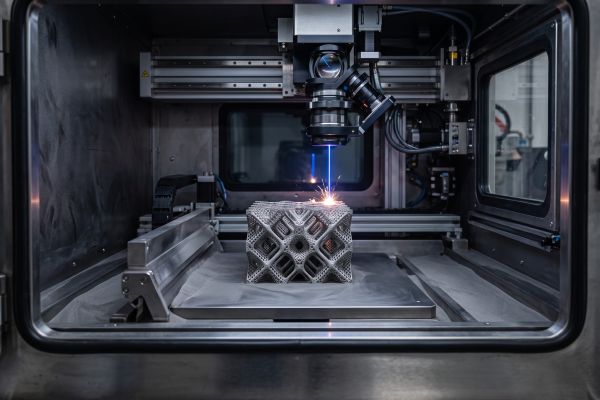
Titanium powder is pyrophoric and reacts aggressively with ambient oxygen at elevated temperatures. A production metal 3D printer processing titanium must maintain an ultra-pure argon atmosphere ($<100\,\text{ppm}\,\text{O}_2$). Operating outside these inerting parameters causes interstitial oxygen pickup. This contamination embrittles the alloy lattice and ruins dynamic fatigue resistance.
Nickel Alloys and Tool Steels Require Different Processing Conditions
Nickel-based superalloys and high-carbon tool steels operate under harsh mechanical stresses. Materials like Inconel 718 and Inconel 625 resist oxidation and creep at temperatures exceeding $650^\circ\text{C}$, matching the ASTM F3055 specification for structural aerospace hardware.
- Nickel Superalloys: Require tight parameter controls to prevent micro-fissuring and strain-age cracking during rapid solidification.
- Tool Steels (H13, Maraging 300): Demand elevated substrate preheating ($>200^\circ\text{C}$) on a metal 3D printer to suppress internal thermal stresses and avoid catastrophic cracking during laser scanning.
Tailoring exposure patterns for these metals prevents thermal residual stress from peeling parts off the baseplate.
Copper and Other Reflective Metals Need Special Consideration
Pure copper and precious metals present unique hurdles for standard infrared fiber lasers ($1060\text{–}1070\,\text{nm}$). Solid copper reflects over 90% of infrared beam energy, which can redirect dangerous back-reflections into optical galvanometer mirrors.
Specialized metal 3D printing systems process pure copper using short-wavelength green lasers ($\approx 515\,\text{nm}$) or ultra-high-power fiber configurations ($>1000\,\text{W}$). The higher absorption rate of green light couples energy directly into the powder bed. This optical shift enables fully dense prints for electrical induction coils and liquid rocket engine heat sinks.
Matching Alloy Metallurgy to Equipment Capabilities
Achieving reliable material performance in metal 3D printing requires selecting a system designed around your target alloy’s thermodynamic behavior. Rather than relying on generic machine compatibility tables, engineering teams must evaluate optical wavelength, substrate preheating thresholds, and inert gas circulation.
A production-grade metal 3D printer must deliver consistent beam delivery and stable atmospheric control across every layer. Pairing qualified alloy powders with a properly configured metal 3D printer ensures that printed components meet structural aerospace, medical, and industrial standards. Contact our engineering team today to review your material specifications and verify process parameters for your target alloys.