What Is the Holy Grail of 3D Printing?
The Ultimate Goal of Additive Manufacturing
3D printing has changed from a rapid prototyping technology into an advanced manufacturing method used in aerospace, medical, automotive, and industrial applications. In the early stage, companies mainly used 3D printers to create prototypes and test designs. Today, manufacturers are exploring how additive manufacturing can become a reliable solution for large-scale production.
The “holy grail” of 3D printing does not refer to a single machine or technology. It represents the ultimate goal of the industry: producing end-use parts faster, cheaper, and more efficiently while maintaining consistent quality.
For many years, engineers have worked to overcome the limitations of traditional additive manufacturing. The future of this technology depends on improving production speed, expanding material choices, reducing costs, and achieving stable manufacturing quality. When these challenges are solved, 3D printing could become a mainstream production technology rather than only a specialized manufacturing method.
The Main Challenges Limiting 3D Printing Development
Although 3D printing technology has advanced significantly, several challenges still prevent wider industrial adoption.
Printing Speed
Printing speed remains one of the biggest barriers for many applications. Traditional manufacturing methods, such as CNC machining and injection molding, can produce large quantities of parts quickly. However, many 3D printing processes still require hours or even days to complete complex components.
For industrial production, manufacturers need 3D printers that can deliver higher productivity without reducing accuracy. Faster printing technologies, improved scanning systems, and optimized manufacturing processes are important steps toward this goal.
Material Limitations
Another challenge is the limited range of available materials. Although modern 3D printers can process plastics, metals, ceramics, and composite materials, many industries still require materials with specific mechanical properties.
For example, aerospace and automotive manufacturers need lightweight materials with high strength, heat resistance, and long-term durability. Expanding material options will allow 3D printing to replace more traditional manufacturing methods.
Production Cost
Cost is another important factor affecting the adoption of additive manufacturing. The price of equipment, materials, maintenance, and post-processing can be higher than conventional manufacturing methods.
For low-volume production or customized parts, 3D printing already provides significant advantages. However, for mass production, manufacturers need lower operating costs and improved equipment efficiency.
Quality Control
Consistent quality is essential for industrial manufacturing. Each printed part must meet strict requirements for dimensions, strength, and reliability.
Advanced monitoring systems, software optimization, and automated inspection technologies are helping manufacturers improve quality control. These developments are especially important for industries such as aerospace, medical devices, and energy.
Is Mass Production the Holy Grail of 3D Printing?
Many experts consider mass production to be one of the ultimate goals of additive manufacturing development. The ability to manufacture thousands or millions of parts with consistent quality would represent a major breakthrough for additive manufacturing.
Currently, 3D printing is widely used for prototyping, customized products, and small-batch manufacturing. These applications benefit from design flexibility and reduced tooling requirements. However, the next stage of development is moving from prototypes to full-scale production.
Industrial adoption is already increasing. Companies are using additive manufacturing to produce lightweight aerospace components, customized medical implants, and complex automotive parts. These applications demonstrate that additive manufacturing can provide unique advantages where traditional manufacturing has limitations.
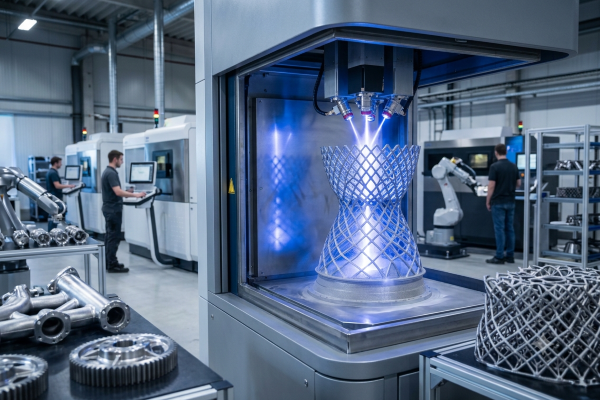
Among different additive manufacturing technologies, metal additive manufacturing has attracted significant attention. Metal 3D printing can create strong, complex components that are difficult or impossible to manufacture using conventional methods. It is becoming an important technology for high-value industrial production.
How Metal 3D Printing Moves Toward This Goal
Metal 3D printing is continuously developing toward faster and more efficient production.
One important direction is faster machines. Modern metal 3D printers are improving laser systems, scanning strategies, and printing processes to increase productivity. More advanced equipment can complete larger builds in shorter timeframes.
Material development is another key area. New metal powders and optimized alloys are expanding the applications of additive manufacturing. Materials such as titanium, aluminum, and stainless steel are increasingly used in industries requiring high-performance components.
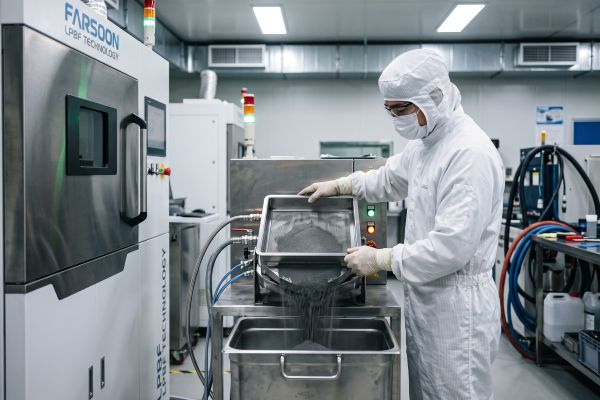
Automation also plays an important role in future development. Automated powder handling, process monitoring, and intelligent software can reduce manual operations and improve production stability.
In addition, larger build volumes allow manufacturers to produce bigger and more complex parts. Large-format metal 3D printers provide greater flexibility for industries that require large components.
Conclusion
The holy grail of additive manufacturing is not simply creating objects layer by layer. It is achieving a future where additive manufacturing can compete with traditional production methods in speed, cost, and reliability.
Although challenges remain, continuous improvements in metal 3D printing, materials, automation, and machine performance are bringing the industry closer to this goal. Contact us to learn more about the future of additive manufacturing and explore professional 3D printing solutions.