How Metal 3D Printing Redefines Lightweighting in Aerospace Structural Components
The aerospace industry faces a constant challenge. Engineers must reduce weight without sacrificing structural integrity. Every extra kilogram increases fuel consumption and operational costs. For decades, engineers relied on traditional CNC machining and casting. These methods are effective, but they have reached their physical limits.
Today, metal 3D printing transforms modern aerospace engineering. Aerospace companies shift from subtractive to additive manufacturing. This change allows them to produce complex, lightweight structural components. Previously, these parts were impossible to make.
The Challenge of Traditional Aerospace Manufacturing
Traditional manufacturing removes material from a solid block of metal. This subtractive process has three major limitations:
- High Buy-to-Fly Ratio: Machining a complex bracket wastes up to 90% of the raw metal block.
- Design Constraints: Traditional cutting tools cannot easily create hollow internal structures or organic, lattice geometries.
- Multi-Part Assemblies: Manufacturers must machine complex structures as separate pieces. Workers then bolt or weld them together. This assembly process adds unnecessary weight. It increases inspection steps and creates extra failure points.
How Metal 3D Printing Enables Next-Generation Lightweighting
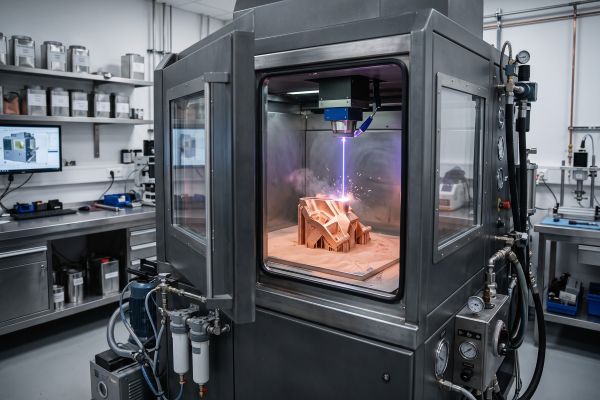
Metal 3D printing builds parts layer by layer directly from CAD models. Specifically, the industry uses Laser Powder Bed Fusion (LPBF). This process unlocks new design freedoms. These freedoms directly drive structural weight reduction.
1. Topology Optimization and Organic Geometries
Topology optimization is a mathematical design approach. It places material only where load paths require it. The resulting designs resemble organic, skeletal structures.
Traditional CNC machines cannot mill these complex, curved shapes. However, metal 3D printing grows these geometries seamlessly.
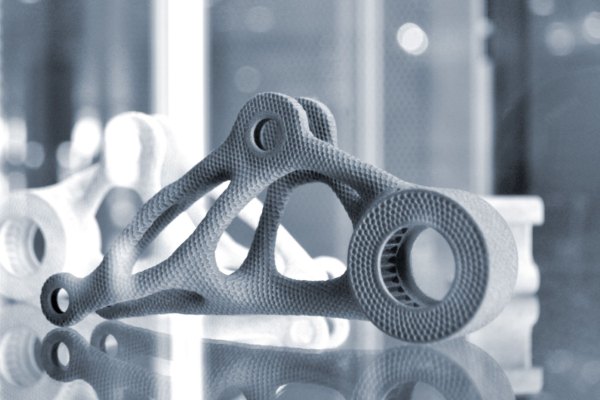
Key Impact: Optimized structural brackets are often 30% to 50% lighter than machined parts. They maintain equal yield strength.
2. Lattice Structures and Internal Voids
Solid metal adds unnecessary weight in low-stress zones. With additive technology, engineers replace solid interiors with complex 3D lattice structures.
- Weight Reduction: These lattices reduce internal density while they preserve outer stiffness.
- Vibration Damping: The internal structures absorb energy and reduce structural resonance during flight.
3. Part Consolidation
Engineers can combine multiple parts into a single monolithic component. This replaces the traditional manufacturing of 10 separate fastened pieces.
- Fewer Fasteners: Monolithic designs eliminate heavy fasteners, rivets, and welds.
- Simpler Assembly: Single-part production eliminates assembly errors and reduces inventory tracking.
- Lower Mass: The unified structure reduces total structural weight significantly.
High-Performance Alloys for Aerospace 3D Printing
Lightweight design requires advanced materials. Advanced metal 3D printing services process high-strength, heat-resistant aerospace alloys. These parts achieve near-zero porosity.
- Ti-6Al-4V Titanium Powder for 3D Printing: This alloy offers an outstanding strength-to-weight ratio. It provides excellent corrosion resistance. The material is ideal for structural brackets, airframe mounts, and wing components.
- Inconel 718 Powder for Metal 3D Printing: This nickel-based superalloy withstands extreme temperatures. It is perfect for rocket engine mounts and turbine components.
- AlSi10Mg Aluminum Powder for 3D Printing: This metal is lightweight and highly conductive. It remains the top choice for satellite housings and heat exchangers.
Business Impact: Why Aerospace OEMs Are Switching
Aerospace purchasing managers and supply chain directors gain clear economic advantages. Adopting metal 3D printing offers benefits beyond just lighter parts.
| Performance Metric | Traditional Machining | Metal 3D Printing |
|---|---|---|
| Material Waste | Very High (up to 90%) | Low (Excess powder is recycled) |
| Assembly Points | Multiple (Welds/Bolts) | Single Consolidated Part |
| Lead Time for Prototypes | 8–16 Weeks | 1–2 Weeks |
| Weight Reduction | Baseline (100%) | Up to 50% Weight Saved |
Long-Term Operational Savings
A lighter aircraft consumes significantly less fuel over its lifecycle. Commercial airlines and satellite launch providers benefit deeply. Saving one kilogram of structural payload translates into tens of thousands of dollars. This saving appears as reduced fuel costs or extra cargo revenue.
Quality Assurance and Certification in Metal AM
Aerospace standards require zero tolerance for defects. Leading B2B metal 3D printing partners follow strict quality control protocols. They meet AS9100 and ISO 9001 standards through four main steps:
- Powder Quality Control: Technicians perform regular sieving and chemistry validation.
- In-Process Monitoring: Systems execute real-time melt pool monitoring during printing.
- Non-Destructive Testing (NDT): Engineers use CT scanning and X-ray testing to verify 99.9% part density.
- Post-Processing & Heat Treatment: Specialists apply Hot Isostatic Pressing (HIP) and stress relief annealing to optimize fatigue life.
Partner with an Experienced Aerospace Metal 3D Printing Manufacturer
Lightweighting is no longer just a trend. It is a core requirement for modern aerospace competitive strategy. Metal 3D printing helps aerospace companies build lighter, stronger, and more efficient systems. It achieves this by combining topology optimization, high-performance alloys, and strict quality control.
Do you want to optimize your structural components? Do you need to shorten development lead times? Contact the Techin Limited engineering team today. You can submit your CAD files for a fast DfAM (Design for Additive Manufacturing) review and quote.