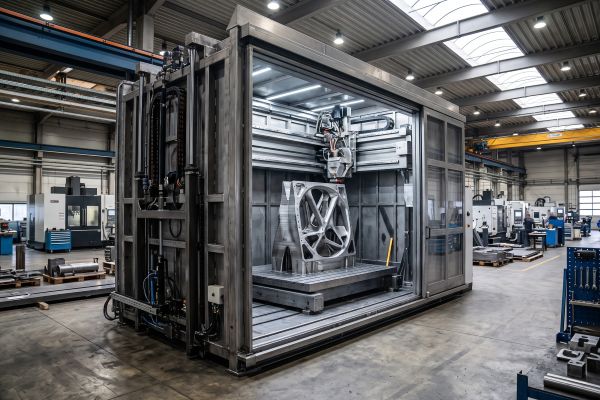
Pure copper Metal 3D Printing has emerged as a transformative technology for thermal management, aerospace propulsion, and high-frequency electrical engineering. Applications such as oxygen-free high-conductivity (OFHC) copper induction coils, liquid rocket engine combustion liners, and high-density semiconductor heat sinks demand extreme density and electrical conductivity. However, pure copper remains notoriously difficult to process via conventional powder bed fusion systems. Its physical profile combines ultra-high thermal conductivity exceeding 390 W/(m·K) with optical reflectivity greater than 90% when exposed to standard near-infrared laser wavelengths.
To overcome these physical limitations, the additive manufacturing industry has split into two competing optical philosophies: high-power infrared (IR) fiber lasers and short-wavelength green lasers. High-power infrared systems rely on brute-force kilowatt energy to force melting, while green laser systems utilize shorter wavelengths to increase natural optical absorption. Choosing between these optical architectures determines equipment cost, microstructural density, optical component lifespan, and overall production economics.
The Physics of Optical Absorption in Pure Copper
Understanding how coherent light interacts with metallic powders is essential for evaluating copper processing hardware. Pure copper behaves almost like an optical mirror when exposed to standard industrial laser sources.
| Laser Wavelength (nm) | Powder Surface Absorption Rate (%) |
| 1064 nm (Infrared) | ~4% – 6% (at room temperature) |
| 515 / 532 nm (Green) | ~35% – 42% (at room temperature) |
| 450 nm (Blue) | ~45% – 50% (at room temperature) |
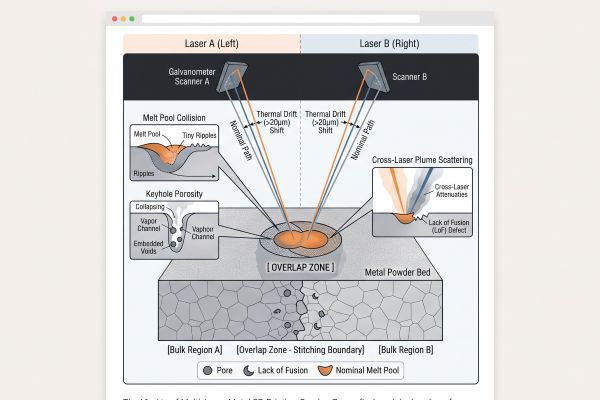
At the standard 1064 nm infrared wavelength, solid copper powder at room temperature absorbs only about 4% to 6% of incident laser energy. The remaining 94% of the energy reflects directly off particle surfaces. This dynamic creates an energy threshold problem. To initiate melting, the machine must deliver extreme power density. However, once the powder transitions from a solid state to a liquid melt pool, its optical absorption abruptly jumps to over 15% to 20%. This non-linear absorption spike causes the melt pool to overheat instantly, creating violent vapor plumes and unstable recoil pressure.
This thermal instability explains why standard pure copper Metal 3D Printing frequently suffers from severe process defects:
- Melt Pool Boiling and Spatter: Sudden over-absorption vaporizes localized copper, ejecting molten droplets across the build platform and creating mechanical inclusions in adjacent scan tracks.
- Keyhole Collapse and Gas Porosity: The intense recoil pressure forms a deep, unstable vapor depression (keyhole). When this keyhole oscillates or collapses, inert shielding gas becomes trapped at the root, forming permanent spherical voids.
- Optical Back-Reflection Damage: Highly reflective scattered photons travel backward along the optical axis, threatening to crack quartz collimator lenses, melt galvo scan mirrors, or burn fiber delivery cores.
Short-wavelength green lasers (515 nm and 532 nm) fundamentally alter this interaction. At 515 nm, the ambient optical absorption of solid copper jumps to 35%–42%. Because base absorption is high from the initial pulse, the transition from solid powder to liquid metal exhibits a minimal absorption gradient. This linear energy coupling allows smooth, predictable melting without thermal shocks or violent vapor blowouts.
Route A: High-Power Infrared Systems in a Metal 3D Printer
The infrared approach uses high-output continuous-wave (CW) fiber lasers operating between 1,000W and 2,000W to overcome low initial absorption.
| Parameter | High-Power Infrared (1000W–2000W) |
| Predominant Melting Mode | Deep Keyhole Mode |
| Relative Density Achieved | 97.0% – 99.2% |
| Spatter Level | Moderate to Severe (requires beam shaping) |
| Laser Source Cost | Lower (Standard industrial fiber laser) |
| Optical Degradation Risk | High (Requires active back-reflection cut) |
Working Principle and Keyhole Dynamics
Infrared systems rely on deep keyhole-mode melting. The laser concentrates over 1 kilowatt of power into a microscopic spot diameter (typically 30–70 $\mu m$). The extreme energy density vaporizes a tiny cavity into the substrate. Multiple internal reflections within this vapor pocket trap the infrared beam, artificially raising effective absorption from 5% to over 60%. This artificial absorption allows the high-power Metal 3D Printer to consolidate copper tracks at high linear scanning velocities.
Technical Advantages
- Capital Equipment Cost: Kilowatt-class infrared fiber lasers are widely commoditized industrial tools. Their integration cost is significantly lower than specialized green or blue laser sources.
- Multi-Material Flexibility: A standard infrared Metal 3D Printer can alternate between copper alloys (such as CuCrZr), nickel superalloys, tool steels, and titanium without requiring specialized optical coatings.
- High Deposition Rates: When processing less reflective copper alloys, high kilowatt output allows large melt pools and thick layer deposition (60 $\mu m$ or higher).
Inherent Limitations
- Process Window Narrowness: Operating within the keyhole regime leaves a tiny operational window between incomplete melting and violent keyhole blowout. Minor variations in powder morphology can induce severe porosity.
- High Residual Stress: Extreme localized temperature gradients generate substantial thermal stress, causing delamination, warping, and support failure in unheated build chambers.
- Hardware Degradation Risks: Even with advanced beam dumps and photodiode interlocks, persistent back-reflected scatter degrades optical coatings over multi-day manufacturing campaigns.
Route B: Green Laser Advancements in Metal 3D Printing
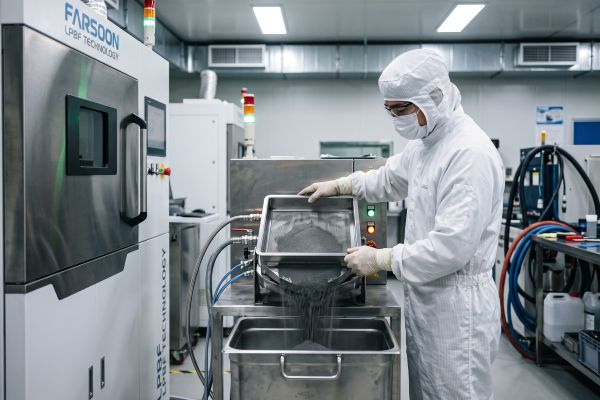
Green laser technology incorporates second-harmonic generation (SHG) crystals to double the frequency of an infrared seed laser, shifting the output wavelength down to 515 nm or 532 nm.
| Parameter | Green Laser (515 nm / 532 nm, 500W–1000W) |
| Predominant Melting Mode | Stable Conduction Mode |
| Relative Density Achieved | 99.8% – 99.95% |
| Spatter Level | Minimal to Near-Zero |
| Laser Source Cost | High (Complex frequency-doubling crystal) |
| Optical Degradation Risk | Low (Absorbed directly by copper surface) |
Working Principle and Conduction Mode Stability
With natural absorption exceeding 35%, green lasers do not need to drill deep vapor keyholes to couple energy into copper powder. Instead, a 500W green laser can operate primarily in conduction mode or shallow-transition mode. Heat transfers smoothly downward through natural thermal conduction rather than violent vapor cavity convection.
Because the melt pool surface remains flat and uniform, shielding gas does not get sucked into molten voids. This process delivers parts with relative densities consistently exceeding 99.85% and electrical conductivities reaching 100% IACS (International Annealed Copper Standard).
Technical Advantages
- Near-Zero Spatter Generation: Smooth energy transfer prevents molten droplets from blowing across the powder bed, preserving surface finish on fine internal channels and thin heat exchanger walls.
- Exceptional Feature Resolution: High absorption allows the optical train to maintain fine spot sizes (down to 30–40 $\mu m$) without risking beam decoupling, enabling complex lattice nodes and 100-micron cooling channels.
- Broad Processing Window: Green laser Metal 3D Printing maintains stability across a wide range of laser powers and scanning speeds, drastically reducing parameter development time.
Inherent Limitations
- High Capital Cost: Green laser sources utilize non-linear optical crystals, active crystal temperature stabilization, and specialized green-reflective mirrors, making them substantially more expensive than standard fiber lasers.
- Limited Laser Output: Commercial green lasers for additive systems typically cap at 500W to 1,000W continuous output, limiting maximum melt pool volume and single-pass layer thickness.
- Thermal Management in Optomechanics: Specialized optical coatings are sensitive to ambient temperature shifts and require closed-loop chilled cooling circuits.
Industrial Hardware Comparison: Modern Metal 3D Printers
When selecting between these systems, industrial users must evaluate comprehensive machine architectures rather than standalone laser specs.
| System Feature | High-Power IR Metal 3D Printer | Green Laser System |
| Standard Build Volume | Medium to Large (up to 400mm³) | Small to Medium |
| Optical Beam Shaping | Ring-mode / Dynamic core-tuned | Fixed Gaussian |
| Inert Gas Atmosphere | Sub-100 ppm Oxygen baseline | Sub-10 ppm Target |
| Pure Cu Density | 97.5% – 99.2% | 99.85% – 99.98% |
| Electrical Performance | 85% – 92% IACS (as-printed) | 98% – 101% IACS |
Industrial Metal 3D Printers equipped with high-power infrared systems increasingly incorporate dynamic beam shaping (such as adjustable ring-mode beams) to mitigate keyhole instability. By surrounding a high-intensity center core with a secondary outer power ring, these machines preheat surrounding powder and stabilize the keyhole wall.
Conversely, green laser systems excel in precision applications. Their laminar gas flow chambers, advanced multi-zone preheating plates, and dedicated powder handling units cater specifically to pure copper, pure silver, and gold alloys.
Conclusion
Choosing between green lasers and high-power infrared depends on your target balance of density, conductivity, and hardware cost. Selecting the proper optical configuration and atmospheric control is essential for repeatable manufacturing success.
Contact our engineering team to request copper print benchmark samples and discuss tailored system configurations for your application.ool mechanics allows manufacturing leaders to deploy the right technology for their specific engineering challenges.