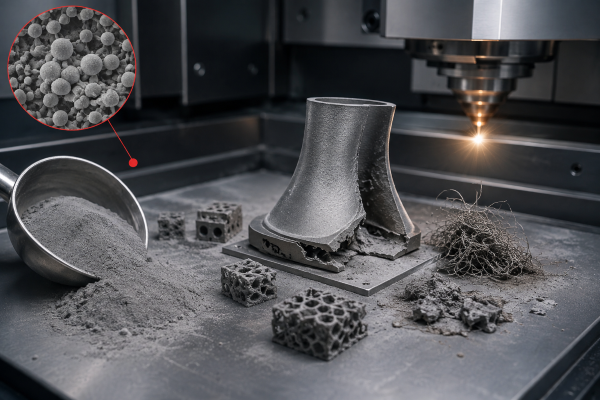
What Defines an Industrial Metal 3D Printer?
An Industrial Metal 3D Printer Delivers Repeatable Production Runs
An industrial metal 3D printer maintains thermal stability and mechanical repeatability across consecutive, multi-day production shifts. Entry-level machines focus mainly on single test coupons. In contrast, industrial platforms eliminate process drift over hundreds of continuous exposure hours.
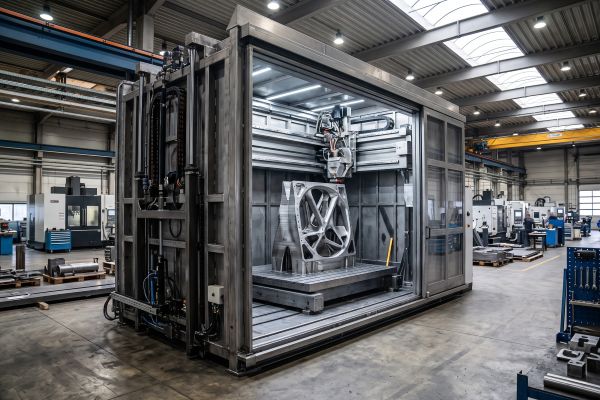
Industrial equipment integrates water-cooled optical benches and automatic powder handling into one rigid frame. The machine also maintains continuous inert gas purification. These connected systems keep part geometry consistent from the first layer to the last.
Optical Train Stability in an Industrial Metal 3D Printer
Laser energy coupling in metal 3D printing depends entirely on optical bench isolation. Uncontrolled thermal expansion shifts the focal plane and causes internal porosity.
Galvanometer motors and f-theta lenses sit inside hermetically sealed, chilled enclosures. Liquid cooling prevents focal drift as motor coils warm up during extended jobs. In multi-laser systems, calibration routines align overlapping exposure zones within twenty microns. This alignment prevents weak boundary lines between separate laser fields.
Protective optical windows feature positive-pressure gas curtains. This laminar barrier deflects rising soot and liquid spatter away from sensitive lenses.
Closed-Loop Powder Handling Protects Operators and Feedstock
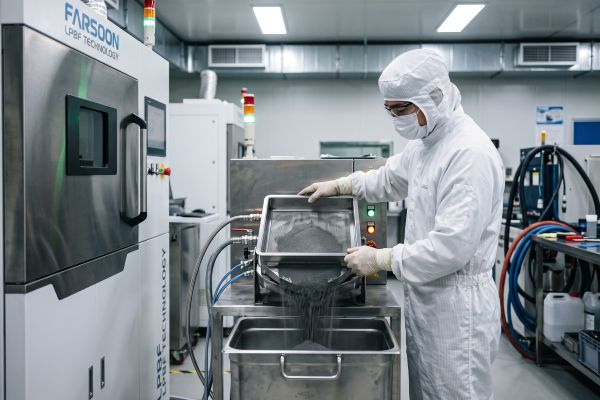
Reactive metal powders ignite easily when exposed to ambient room air. Therefore, an industrial metal 3D printer isolates fine particles from human contact.
Automated ultrasonic sieves screen recycled powder under continuous argon flow. Closed pneumatic circuits convey conditioned powder between hoppers and dosing units. Operators never open the chamber door during powder replenishment cycles. Electrical enclosures and relief vents comply with the NFPA 484 combustible metal standard.
Automated powder transport cuts turnover intervals between successive builds on commercial metal 3D printers.
Chamber Atmosphere and Inert Recirculation Dynamics
Consolidating reactive alloys requires oxygen levels below one hundred parts per million. Industrial systems use closed-loop gas purification circuits to maintain this purity.
Internal circulation blowers push argon across the active powder bed. This steady crossflow sweeps hot vapor plumes away from the laser beam path. The exhaust gas passes through a cyclonic spark trap and secondary HEPA filters.
Electrochemical sensors measure chamber oxygen content in real time. Micro-dosing valves inject fresh argon automatically whenever oxygen levels increase.
Heavy Rigidity and Recoater Mechanics in an Industrial Metal 3D Printer
Mechanical vibration inside the process chamber ruins fine layer consistency. Heavy machine foundations prevent dimensional errors across tall parts.
The build platform rests on precision-ground cast iron bases. This heavy structure absorbs floor vibrations from nearby factory equipment. Modern systems spread powder on both forward and return strokes. This dual-direction recoating eliminates idle travel and shortens layer cycle times.
Torque sensors monitor the recoater blade during every movement. The drive system detects raised part edges instantly to prevent mechanical collisions.
Production Line Integration and Plant Connectivity
Operating an industrial metal 3D printer inside a digital factory requires direct network compatibility. Modern machine controllers interface directly with enterprise execution software.
Standard communication protocols stream sensor readings and layer images to execution systems. Optical cameras record the powder bed before and after every laser pass. These diagnostic logs verify quality compliance under the ISO/ASTM 52920 standard.
Standardized zero-point receivers clamp the base plate securely. Robotic arms extract finished build plates directly into post-processing stations without manual realignment.
Evaluating an Industrial Metal 3D Printer for Factory Operations
Selecting an industrial metal 3D printer requires auditing mechanical endurance, powder isolation, and atmospheric controls. A production-ready machine must deliver consistent density and tight tolerances across long manufacturing campaigns. Sealed optical benches and automatic gas scrubbing protect build quality from common environmental variables.
These integrated systems minimize unscheduled downtime during busy production schedules. If your facility plans to expand metal 3D printing capacity, contact our technical engineering team to evaluate your component requirements.