Global Additive Manufacturing Market Analysis: Industry Value Chain and Application Trends (Part 2)
5. Market Size and Industry Landscape
Global Market Continues to Grow Rapidly
The global additive manufacturing market has significant growth potential and is expected to maintain strong momentum in the coming years.
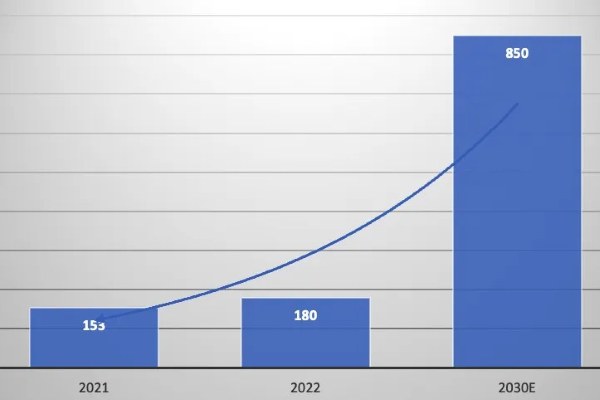
According to Wohlers Associates, the global additive manufacturing market reached USD 18.03 billion in 2022. The industry achieved a compound annual growth rate (CAGR) of 25.6% over the past 34 years. The global market is projected to reach USD 85.3 billion by 2030, equivalent to nearly RMB 600 billion.
China Remains One of the Fastest-Growing Markets
China’s additive manufacturing market is expected to exceed RMB 50 billion in the near term. Long-term growth potential remains substantial.
According to the China Additive Manufacturing Industry Alliance, China’s 3D printing market reached RMB 33 billion in 2022. The market recorded a CAGR of 28% between 2018 and 2022.
Data from CCID Consulting indicates that China’s market could exceed RMB 50 billion by 2024.
Despite this rapid growth, additive manufacturing still represents less than 0.1% of China’s manufacturing industry. The technology remains in the early stage of industrial adoption. Long-term manufacturing penetration is expected to reach 3% to 5%.
China Leads in Industrial AM Installations
Research from Wohlers Associates shows that China has become one of the world’s leading markets for industrial additive manufacturing equipment.
Globally, 34.9% of installed industrial AM systems are located in North America. 30.7% are installed in Europe, while 28.4% are located in the Asia-Pacific region.
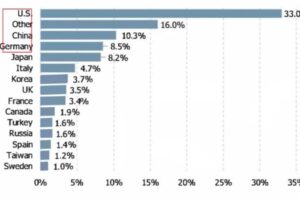
At the national level, the United States, China, and Germany have the largest installed bases of industrial additive manufacturing systems.
Market Competition Continues to Intensify
The additive manufacturing industry remains relatively fragmented. Market concentration is still low, while competition continues to increase.
According to Wohlers Associates, the world’s ten largest system manufacturers generated approximately USD 2.72 billion in revenue during 2022. Together, they accounted for only 15.1% of the global additive manufacturing market.
Emerging equipment suppliers continue to increase their market share.
In previous years, service providers mainly purchased equipment from established manufacturers such as 3D Systems, EOS, and Stratasys.
However, this trend has gradually changed.
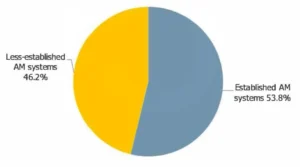
Among the 290 industrial systems purchased by service providers in 2022, 156 systems came from emerging manufacturers. These suppliers accounted for 53.8% of total purchases.
This marked the third consecutive year that service providers increased purchases from newer equipment manufacturers, reflecting growing market competition and improving technology across the industry.
6. Industry Value Chain
The additive manufacturing industry consists of upstream suppliers, equipment manufacturers and service providers, and downstream application industries.
The upstream segment includes materials, core hardware, supporting equipment, software, and digital tools.
The midstream segment consists of equipment manufacturers and printing service providers for both metal and polymer additive manufacturing.
The downstream segment includes industries such as aerospace, healthcare, tooling, automotive, energy, and industrial manufacturing.
Upstream: Lasers and Galvanometer Systems
Lasers are one of the most important core components in additive manufacturing systems. Common laser types include fiber lasers and CO₂ lasers.
Localization of Fiber Lasers Continues to Improve
According to Laser Focus World, China’s fiber laser market reached approximately USD 1.38 billion in 2020.
Domestic manufacturers accounted for approximately 56% of the market, representing about USD 773 million in sales.
Although the American manufacturer IPG Photonics remained the largest supplier in China, its market share has gradually declined. Chinese companies such as Raycus, Maxphotonics, and JPT have continued to expand their presence.
Most low- and medium-power fiber lasers used in additive manufacturing are now supplied by domestic manufacturers.
Galvanometer Systems
Galvanometer scanners are another key component in laser-based additive manufacturing systems.
According to the 2021 China Laser Industry Development Report, China’s galvanometer market reached approximately RMB 840 million in 2021.
Domestic suppliers dominate the mid-range market, while international brands still lead the high-end segment.
Major international suppliers include CTI, SCANLAB, and Raylase.
Chinese manufacturers include Han’s Scanner, Jinhai Chuang, Zhibotec, Century Sunny, and Feilitec.
Domestic galvanometer systems have already gained meaningful market share among Chinese additive manufacturing equipment manufacturers. Further import substitution is expected in the coming years.
Upstream: Materials
Material Market Continues to Expand
The global additive manufacturing materials market has maintained strong growth in recent years.
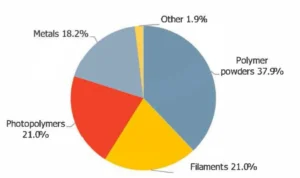
According to Wohlers Associates, the global market for additive manufacturing materials reached USD 3.26 billion in 2022, representing a 25.5% year-on-year increase from USD 2.60 billion in 2021.
Polymer powders accounted for 37.9% of the market, followed by filaments (21%), photopolymer resins (21%), and metal powders (18.2%).
According to the China Additive Manufacturing Industry Alliance, China’s 3D printing materials market reached RMB 1.47 billion in 2021. Non-metal materials accounted for 63%, while metal materials represented 37%. The share of metal materials was higher than the global average.
Materials for Different Applications
Additive manufacturing materials mainly include photopolymer resins, polymer powders, filaments, and metal powders.
Photopolymer resins and filaments are primarily used in consumer-grade 3D printing. Polymer powders and metal powders are mainly used in industrial applications.
Common metal materials include titanium alloys, cobalt-chromium alloys, stainless steel, and aluminum alloys.
Titanium alloys offer high strength, excellent corrosion resistance, and good heat resistance. These properties make them suitable for aircraft compressor components, rockets, missiles, and aerospace structural parts.
Photopolymer resins are widely used to produce high-strength, heat-resistant, and water-resistant components. Typical applications include automotive products, home appliances, and consumer electronics.
Material Availability Remains a Limitation
Compared with conventional manufacturing, additive manufacturing requires materials with much stricter specifications.
For example, metal powders must meet requirements for oxygen content, particle size distribution, and powder flowability. These characteristics directly affect printing quality and process stability.
Material qualification also requires significant time and investment. As a result, the limited availability of qualified materials continues to restrict adoption in some industrial applications.
Representative Material Suppliers
Representative suppliers of metal powders include GRIPM Advanced Materials, AVIC Maite, Vilory, and Ningbo Zhongyuan.
Representative suppliers of polymer materials include Farsoon, Polymaker, and BASF.
Upstream: Software and 3D Scanners
Software and digital tools are becoming increasingly important throughout the additive manufacturing workflow.
The global 3D scanner market approached USD 3 billion in 2023, with a projected five-year compound annual growth rate of approximately 15%.
International manufacturers entered this market at an early stage. ZEISS, for example, has developed 3D scanning technologies since the 1970s.
Chinese companies have recently achieved significant progress in specialized applications such as dental scanning. Representative manufacturers include Shining 3D and Scantech.
Additive manufacturing software supports every stage of production.
Typical software functions include:
- Topology optimization
- Generative design
- Algorithm-based modeling
- Model repair
- Process simulation
- Slicing and build preparation
- Print management
- Production monitoring
- MES-based production tracking
Many equipment manufacturers also develop proprietary software to improve process control, printing efficiency, and overall product performance.
Midstream: 3D Printing Equipment Manufacturers
The equipment manufacturing segment continues to expand as industrial demand grows.
More than 26,000 industrial 3D printers were sold worldwide in 2021. The industry achieved a ten-year compound annual growth rate of approximately 14%.
The largest installed equipment bases are located in the United States, China, and Japan.
The leading equipment manufacturers include Stratasys, Formlabs, and 3D Systems.
Among all technology routes, SLM and SLS accounted for approximately 32% of the market. FDM represented 15%, SLA accounted for another 15%, and DLP represented 14%. Together, these four technologies accounted for approximately 76% of the global market.
The number of additive manufacturing equipment manufacturers also continued to increase. Compared with 2021, the industry added 20 new manufacturers in 2022, representing growth of approximately 7.5%.
China’s Equipment Manufacturers Continue to Grow
China’s additive manufacturing industry includes companies of various sizes.
In 2021, consumer-focused manufacturers such as Creality and Anycubic generated annual revenue exceeding RMB 1 billion.
Approximately 16 companies, including Farsoon and BLT, reported annual revenue between RMB 200 million and RMB 1 billion.
Around 60 companies generated annual revenue between RMB 50 million and RMB 200 million.
More than 100 additional companies reported annual revenue below RMB 50 million, demonstrating the fragmented nature of China’s additive manufacturing equipment market.
Midstream: 3D Printing Service Providers
3D printing service providers support customers throughout the manufacturing process.
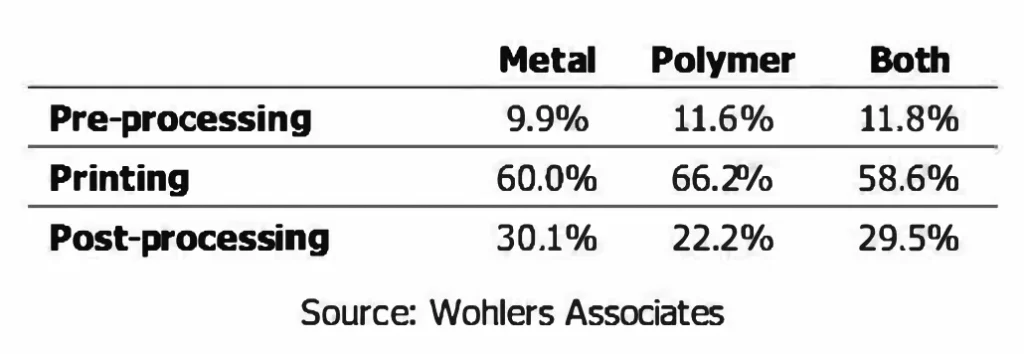
Typical services include model repair, build orientation optimization, part nesting, build preparation, printing, support removal, cleaning, surface finishing, and other post-processing operations.
The cost contribution of each production stage varies throughout the complete printing workflow.
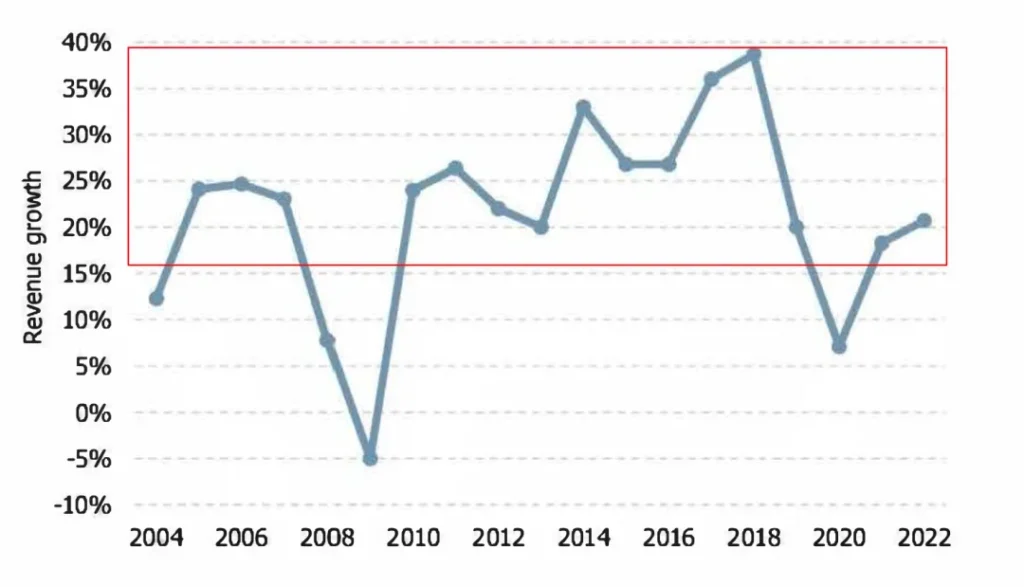
Over the past decade, additive manufacturing service providers have maintained strong revenue growth.
For most years, annual revenue growth exceeded 15%, reflecting increasing demand for outsourced additive manufacturing services.
7. Downstream Applications
Additive manufacturing has been adopted across many industries. Globally, the largest application sectors include aerospace, healthcare, and automotive manufacturing. In China, aerospace remains the dominant application. In 2021, the aerospace industry contributed 58% of the country’s total additive manufacturing output value.
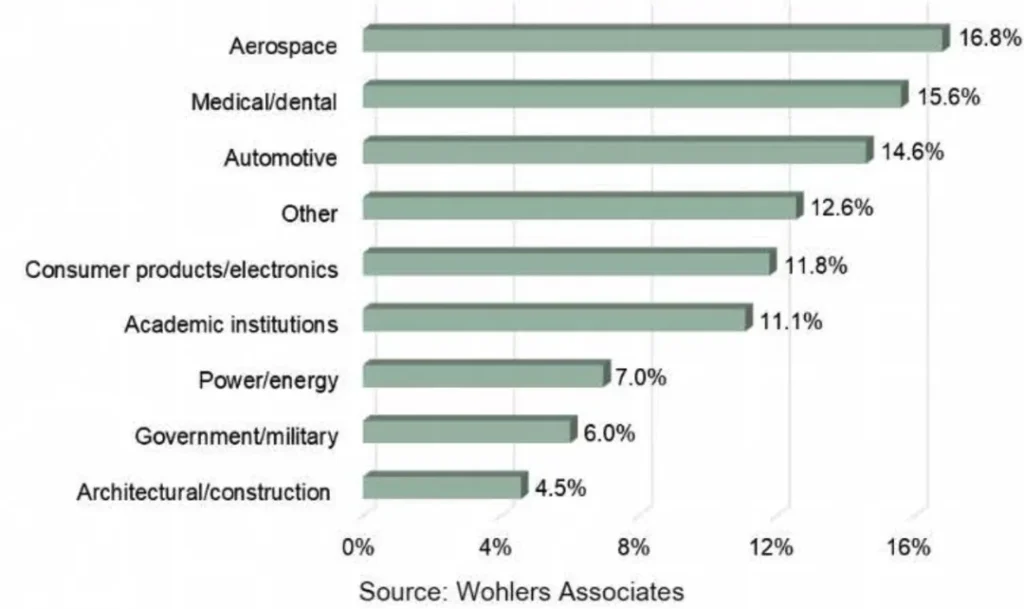
Aerospace
Aerospace is one of the most important markets for additive manufacturing.
According to Wohlers Associates, the global aerospace additive manufacturing market reached USD 2.56 billion in 2021, representing 30% year-on-year growth.
Despite this strong growth, market penetration remains low. According to Safran, approximately 25% of future aircraft engine components could be produced by additive manufacturing. Current penetration is only about 0.19%, indicating significant long-term growth potential.
According to forecasts from Huatai Securities, additive manufacturing could achieve different penetration levels in aircraft structural components and landing gear between 2021 and 2030. Under conservative, base-case, and optimistic scenarios, China’s military aircraft additive manufacturing market could reach RMB 15.27 billion, RMB 25.44 billion, and RMB 50.89 billion, respectively.
Key Aerospace Applications
Additive manufacturing is widely used in aircraft engines, unmanned aerial vehicles (UAVs), and commercial launch vehicles.
According to Huatai Securities, long-term adoption is expected to be highest in missiles, followed by aircraft engines and military aircraft.
Compared with conventional casting and forging, additively manufactured components offer higher design flexibility and can produce much more complex geometries. These advantages make additive manufacturing well suited for lightweight structures and topology-optimized designs.
However, additively manufactured parts generally have lower fatigue performance than forged components. Material selection and process optimization therefore remain critical for high-reliability applications.
Military Aircraft
Forging remains the preferred manufacturing method for many military aircraft structures.
Military aircraft operate under demanding conditions and require long service lives. Structural components must provide both high static strength and excellent fatigue resistance.
Most aircraft structural components are also relatively large and geometrically simple. These characteristics make conventional forging more suitable than additive manufacturing for many primary airframe structures.
Aircraft Engines
Aircraft engines present greater opportunities for additive manufacturing.
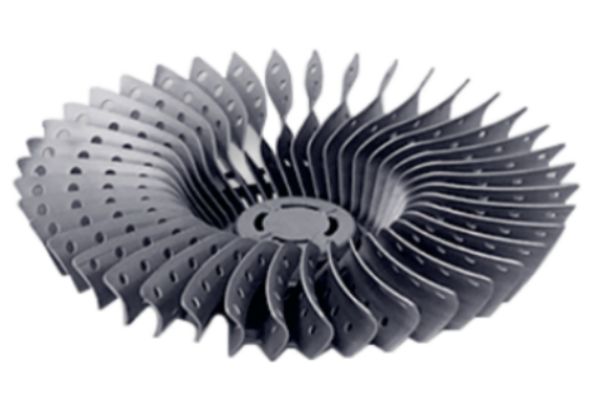
Engine components operate under extremely harsh conditions and often feature highly complex internal geometries. These designs are difficult or impossible to manufacture using traditional methods.
Aircraft engines require both high static strength and good fatigue resistance. As a result, casting, forging, and additive manufacturing each play important roles depending on the component.
Many critical engine components are manufactured from superalloys, which account for approximately 40% to 60% of total engine weight. Typical applications include turbine disks, guide vanes, combustors, and afterburners.
Because many superalloys have poor weldability, their processing characteristics also influence the long-term adoption of additive manufacturing in aircraft engines.
Missiles
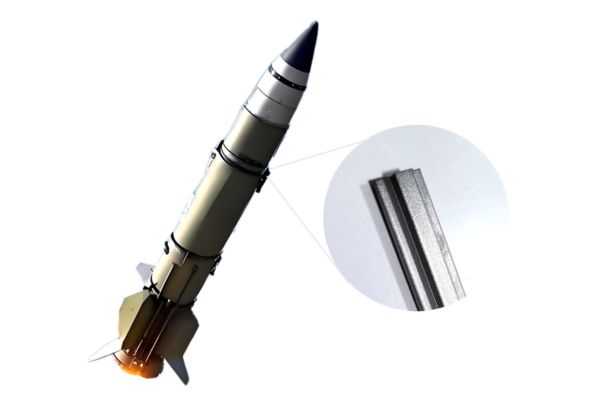
Missiles are well suited to additive manufacturing.
Unlike aircraft, missiles are single-use systems. They place less emphasis on long-term fatigue performance while requiring high structural strength and complex internal geometries.
These characteristics make additive manufacturing an attractive production method for many missile components.
Value of Additive Manufacturing in Aerospace
The value of additive manufacturing extends beyond manufacturing efficiency.
Optimized structures can significantly reduce component weight, lower production costs, and improve overall system performance. The technology also enables advanced topology optimization that cannot be achieved through conventional manufacturing.
For example, nTopology collaborated with the Air Force Institute of Technology (AFIT) to manufacture a lattice support structure for a CubeSat using Inconel 718. Compared with a conventional aluminum design, the new structure reduced weight by 50%, reduced the number of parts from 150 to 25, and significantly improved structural stiffness.
Another example comes from Thales Alenia Space and the European Space Agency (ESA). The two organizations developed a lattice filling algorithm for complex load-bearing structures and applied it to deployable solar panel systems through additive manufacturing.
Compared with conventional designs, the new structure reduced weight by 80%, reduced the number of components by 90%, and lowered manufacturing costs by 75%.
Healthcare
Healthcare is another major application area for additive manufacturing.
Current applications include personalized implants, mass-produced orthopedic implants, and dental products.
Personalized Implants
Additive manufacturing enables highly customized medical implants that match each patient’s anatomy.
In plastic and reconstructive surgery, customized polymer and silicone implants can restore facial and body structures.
In oral and maxillofacial surgery, patient-specific titanium plates can stabilize bone segments after surgery. Customized implants can also replace the temporomandibular joint when necessary.
In orthopedic surgery, titanium implants are widely used to replace bone lost through trauma or tumor removal.
One representative application is patient-specific cranial implants used in cranioplasty to repair skull defects.
Mass-produced Medical Implants
Additive manufacturing is also used to produce standardized medical implants.
Typical products include spinal fusion cages manufactured from titanium alloys or polyetherketoneketone (PEKK).
Other common applications include acetabular cups made from titanium or cobalt-chromium alloys, tibial baseplates for total knee replacement, and titanium wedges used to fill bone defects in limb reconstruction.
Dental Applications
In dentistry, additive manufacturing is used to produce models for crowns, bridges, and inner crowns.
Although adoption remains relatively low, market growth continues to accelerate.
The penetration rate of 3D printing in dental care was below 2% in 2020, with a global market size of approximately USD 1.9 billion.
According to Stratview Research, the global dental additive manufacturing market is expected to reach USD 8.6 billion by 2026, representing a compound annual growth rate of approximately 29%.
Representative companies include Align Technology and other digital dentistry solution providers.
Tooling
Tooling is another important application for additive manufacturing.
Mold manufacturing typically involves complex production processes, low production volumes, and highly customized designs. These characteristics make it well suited for additive manufacturing.
3D printing can significantly shorten mold production time while reducing total lifecycle costs.
For example, PepsiCo used additive manufacturing to produce molds for beverage bottles. Conventional manufacturing required approximately six weeks to complete one mold. With 3D printing, the same mold could be produced in about 12 hours. Manufacturing costs were reduced from approximately USD 10,000 to USD 350 per mold, representing a lifecycle cost reduction of about 96%.
Another important advantage is conformal cooling.
Unlike conventional straight cooling channels, conformal cooling channels follow the geometry of the mold. This design improves cooling efficiency and reduces part deformation during molding. Depending on the application, conformal cooling can reduce deformation by 15% to 90%.
Automotive
The automotive industry is expanding its use of additive manufacturing throughout product development and manufacturing.
For powertrain development, additive manufacturing is used to produce engine and transmission components. Typical applications include turbocharger components, transmission housings, and functional prototypes.
For example, Robert Hofmann GmbH produced a fully functional lightweight aluminum engine block for Volkswagen, demonstrating the feasibility of metal additive manufacturing for complex automotive components.
Additive manufacturing also supports electrical and electronic system development.
Engineers can use 3D printing to validate bracket designs for body control modules before mass production. Combined with structural analysis and vehicle installation testing, additive manufacturing helps identify design issues early, optimize part geometry, improve structural strength, and enhance manufacturability.
These capabilities shorten product development cycles and improve overall product maturity before volume production.
Energy and Other Industrial Applications
Additive manufacturing is gradually expanding into the energy sector and other industrial applications.
Current research and commercial projects focus on improving the performance and production efficiency of components such as wind turbine parts, battery systems, and centrifugal pump impellers.
As material performance and manufacturing processes continue to improve, additive manufacturing is expected to support a wider range of energy and industrial equipment applications.
Conclusion
Additive manufacturing has evolved from a rapid prototyping technology into an important manufacturing solution for industrial production.
The global market continues to grow rapidly, driven by advances in equipment, materials, software, and digital manufacturing technologies. China has also become one of the world’s largest additive manufacturing markets and continues to strengthen its position across the industry value chain.
The upstream supply chain is becoming more localized, particularly in lasers, galvanometer systems, and metal materials. Equipment manufacturers continue to improve process capabilities, while service providers are expanding to meet increasing industrial demand.
Among downstream industries, aerospace remains the most mature application market, followed by healthcare, tooling, automotive, and energy. These industries benefit from additive manufacturing’s ability to produce lightweight structures, highly complex geometries, and customized components while reducing development time and improving manufacturing efficiency.
Although challenges remain in material qualification, production cost, and large-scale manufacturing, additive manufacturing is still in the early stage of industrial adoption. As laser technology, materials, process control, and Design for Additive Manufacturing (DfAM) continue to advance, the technology is expected to achieve broader adoption across modern manufacturing.
Looking ahead, additive manufacturing will continue to evolve from a specialized production method into a core manufacturing technology, supporting the digital transformation of industries worldwide.
Work with TECHIN LIMITED
As additive manufacturing continues to reshape modern manufacturing, choosing the right partner is key to achieving reliable and efficient production.
TECHIN LIMITED provides industrial metal 3D printing solutions, including equipment, materials, software, spare parts, and printing services. Contact our team to discuss your application and discover the right solution for your business.
Editor’s Note: This article was originally published by Net Ventures (信天创投) and authored by Feng Yi (冯驿).