How Many Times Can You Safely Recycle Powder in Metal 3D Printing?
Metal powder can be safely recycled between 10 to 50+ times in metal 3D printing, depending on alloy sensitivity and blending discipline. Stainless steels like 316L consistently run past 30 to 50 cycles with routine fresh powder additions. In contrast, reactive alloys like Ti-6Al-4V face a tighter limit of 10 to 15 cycles due to rapid gas pickup.
There is no fixed cycle cap across all materials. Safe reuse in metal 3D printing depends on controlling oxygen pickup, preserving spherical particle shape, and screening out weld spatter.
This guide outlines physical degradation modes, top-up blending formulas, and testing gates for metal 3D printer powder reuse.
Quick Answer: Safe Limits for Powder in Metal 3D Printing
With an active top-up strategy, 316L stainless steel runs reliably past 30 to 50 cycles. In contrast, interstitial oxygen pickup Ti6Al4V caps titanium reuse at 10 to 15 cycles. Safe limits depend strictly on chemical thresholds, especially keeping total oxygen content below mandatory standards like ASTM F2924 ($<0.20\,\text{wt}\%$ for Grade 5 titanium).
Material Benchmark Table
| Alloy Grade | Proven Re-use Cycles | Critical Rejection Limit | Primary Degradation Mode |
| 316L / 17-4 PH | $30 – 50+$ Cycles (with Top-Up) | Oxygen $>0.08\,\text{wt}\%$, No Hall Flow | Spatter agglomeration, fines depletion |
| Inconel 718 / 625 | $20 – 30$ Cycles | Oxygen $>0.04\,\text{wt}\%$, Trace element loss | High-temperature surface oxidation |
| Ti-6Al-4V (Grade 5/23) | $10 – 15$ Cycles | Oxygen $>0.20\,\text{wt}\%$ (ASTM F2924) | Interstitial embrittlement, drop in ductility |
| AlSi10Mg | $15 – 20$ Cycles | Hydrogen spike, Hall Flow stall | Oxide skin growth, moisture absorption |
The 3 Physical & Chemical Degradation Modes of Reused Powder
During laser scanning, un-melted feedstock undergoes intense thermal and mechanical stresses. Three distinct degradation modes drive powder degradation SLM processes over repeated builds.
1. Interstitial Oxygen and Nitrogen Pickup
Reactive alloys continuously pick up gas impurities during laser processing. Even in high-purity argon atmospheres, superheated spatter ejected from the melt pool reacts instantly with trace oxygen.
These oxidized particles settle across the powder bed, forming a thick oxide passivation layer on outer surfaces. When reused in subsequent metal 3D printing builds, the laser cannot consolidate this oxidized skin cleanly. More critically, interstitial oxygen dissolves directly into the molten matrix. In titanium alloys, this interstitial buildup causes severe embrittlement: static yield strength rises slightly, but tensile elongation and fracture toughness drop below aerospace safety minimums.
2. Loss of Sphericity & Satellite Formation
High packing density requires smooth, spherical particles produced during gas atomization. Repeated thermal cycles and mechanical handling quickly degrade this spherical geometry:
- Mechanical Damage: Vacuum extraction and pneumatic conveyance deform individual grains into irregular shapes.
- Satellite Welds: Sub-micron condensates and molten spatter droplets weld themselves onto larger particles.
- Poor Recoating Flow: These irregular satellites increase friction between particles, degrading Hall Flow rates and causing voids during powder recoating in metal 3D printing.
3. Particle Size Distribution (PSD) Drift
Many production teams assume powder aging is purely chemical, but the physical particle size distribution shifts continuously across recycling cycles.
The chamber filtration system continuously pulls out fine particles ($<15\,\mu\text{m}$) along with laser condensate. Over multiple builds, the PSD curve drifts toward larger average particle diameters ($D_{10}$ and $D_{50}$). Without fine particles to fill gaps between larger grains, apparent packing density drops. This change alters laser energy absorption, causing unexpected melt pool variations during standard metal 3D printing runs.
Industrial Life-Extension: Managing Powder in Metal 3D Printing
High-volume operations prevent sudden scrap events by combining closed-loop inert sieving with a structured metal powder top-up strategy.
Virgin-to-Recycled Blending Protocols
Rather than running full batches to complete exhaustion, industrial facilities mix virgin powder into recovered powder before every build. This constant dilution prevents chemical concentration and maintains a steady-state oxygen balance in production metal 3D printing.
Engineers calculate this steady-state oxygen level ($C_{eq}$) using a basic mass-balance model:
$$C_{eq} = \frac{R \cdot (C_{prev} + \Delta C) + (1 – R) \cdot C_{virgin}}{1}$$
Where:
- $R$ = Recycled powder fraction ($0.70$ or $0.80$)
- $(1 – R)$ = Virgin top-up fraction ($0.30$ or $0.20$)
- $C_{prev}$ = Existing batch oxygen concentration ($\text{wt}\%$)
- $\Delta C$ = Net oxygen picked up during a single print cycle ($\text{wt}\%$)
- $C_{virgin}$ = Baseline oxygen concentration of new powder ($\text{wt}\%$)
In high-volume metal 3D printing, an 80:20 blend ratio (80% recycled, 20% virgin) balances an average $+0.006\,\text{wt}\%$ oxygen pickup per run, stabilizing at an equilibrium of $\sim 0.165\,\text{wt}\%$. Because this stays safely below the $0.20\,\text{wt}\%$ ceiling, the batch cycles indefinitely without compromising mechanical properties. For flight-critical parts with narrow quality margins, switching to a 70:30 ratio provides an added safety cushion.
Ultrasonic Inert Vibratory Sieving
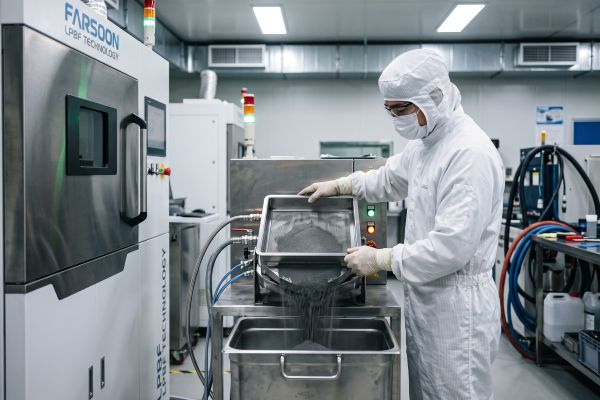
Blending alone cannot fix mechanical contamination. After every build, recovered powder must pass through automated screening hardware to protect the metal 3D printer:
- Acoustic Mesh Screening: An ultrasonic mesh (typically $45\,\mu\text{m}$ to $63\,\mu\text{m}$) breaks up agglomerates and filters out oversized spatter.
- Inert Atmosphere Protection: Sieving occurs under positive-pressure argon ($O_2 < 100\,\text{ppm}$) to prevent warm metal from absorbing room moisture.
- Flow Restoration: Removing deformed spatter restores bulk powder flowability, ensuring smooth, streak-free recoater passes during metal 3D printing.
Quality Assurance: Critical Lab Tests Before Every Critical Build
To ensure process repeatability across dozens of reuse cycles, production facilities enforce strict ASTM F3049 powder testing protocols before releasing reused batches for metal 3D printing:
- Inert Gas Fusion (ONH Testing): Using an ONH analyzer per ASTM E1409 and E1447, technicians measure interstitial oxygen, nitrogen, and hydrogen to parts-per-million precision. Any titanium batch exceeding $0.20\,\text{wt}\%$ oxygen is quarantined immediately.
- Flow Characterization (Hall & Carney Funnel): Operators measure flow rates and apparent density per ASTM B213 and ASTM B964. If powder fails to flow freely through a standard $2.5\,\text{mm}$ Hall orifice without tapping, the batch requires immediate re-sieving.
- MES Tracking with Smart Hoppers: Modern facilities tag powder containers with RFID chips. The Manufacturing Execution System logs cumulative laser exposure, sieving dates, and top-up ratios automatically, eliminating human error in metal 3D printing feedstock tracking.
Conclusion & Next Steps
You do not need to discard metal powder after arbitrary cycle limits. By pairing inert ultrasonic sieving with a disciplined 80:20 virgin top-up protocol and routine ONH testing, manufacturing teams can safely reuse steel and superalloy powders for dozens of cycles in metal 3D printing while maintaining aerospace-grade mechanical properties.
Ready to cut feedstock costs while protecting build quality? Get in touch with our engineering team today to discuss your project requirements and see how we can help.