Topology Optimization for Metal 3D Printing: Bridging the Gap Between Design and Manufacturability
As the aerospace and automotive sectors push the boundaries of performance, reducing structural weight while maintaining high strength is a critical challenge. Traditional lightweight design has reached its physical limits.
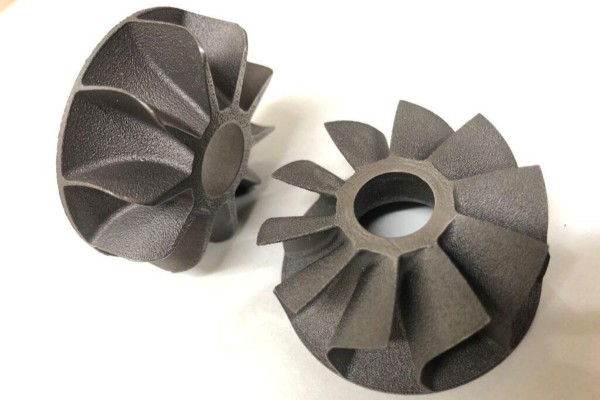
Enter Topology Optimization (TO). By mathematically distributing material within a defined space based on real-world loads, TO creates highly efficient, bio-inspired structures. When paired with the “design freedom” of metal additive manufacturing (AM), it unlocks unprecedented performance—such as a 66% weight reduction in turbine engine brackets.
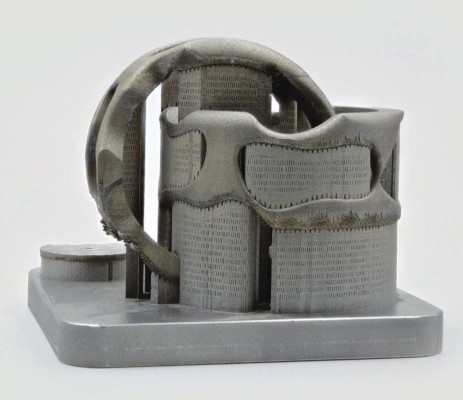
However, metal 3D printing is not entirely “constraint-free.” Issues like minimum wall thickness, severe thermal stress, overhang collapse, and trapped powder can cause prints to fail.
To bridge this gap, this comprehensive review outlines how modern topology optimization algorithms are evolving to incorporate metal AM constraints directly into the design phase.
1. Core Topology Optimization Methods: Element-Based vs. Boundary Evolution
Topology optimization algorithms generally fall into two categories, each with its own strengths and manufacturability hurdles.
Element-Based Methods (Mesh-Dependent)
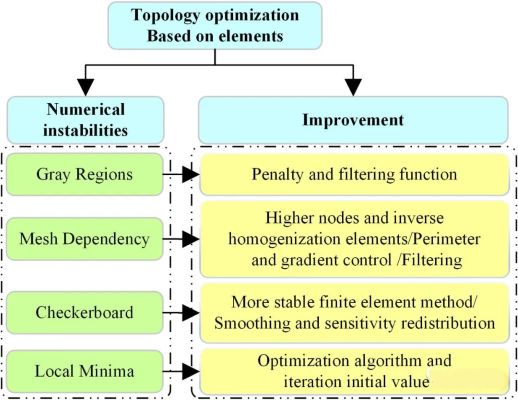
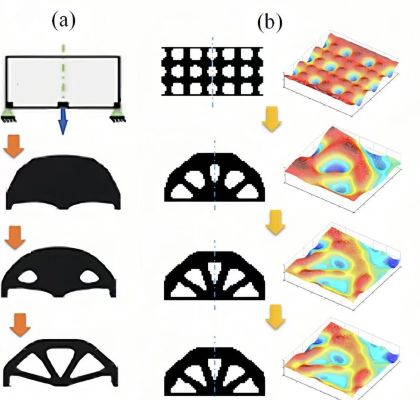
- SIMP (Solid Isotropic Material with Penalization): This widely applied method uses an element “pseudo-density” between 0 and 1 to find the optimal load path. It is computationally fast but can suffer from numerical instabilities like “checkerboard” patterns and grayscale elements.
- BESO (Bi-directional Evolutionary Structural Optimization): This method gradually removes inefficient material and adds material where stress is high. However, it often produces jagged, sawtooth edges along structural boundaries.
To make these mesh-based designs manufacturable, engineers apply density filtering, gradient constraints, and multi-start optimizations to eliminate gray zones and establish clean, distinct solid boundaries.
Boundary Evolution Methods (Mesh-Independent)
- Level Set Method (LSM): Uses dynamic implicit boundaries to track shapes perfectly, eliminating checkerboard patterns. Its limitation is a high dependence on initial guesses and an inability to introduce new holes automatically during optimization.
- MMC/MMV (Moving Deformable Components/Voids): Uses explicit geometric components to optimize structural layouts with significantly fewer design variables, offering seamless integration with CAD/CAE software.
2. Overcoming Metal Additive Manufacturing Constraints
To ensure an optimized structure doesn’t fail on the print bed, advanced TO software must account for three critical types of manufacturing constraints.
A. Geometric Constraints (Size Limitations)
If a topology routine generates a strut thinner than the laser spot diameter, the printer cannot resolve it. Conversely, massive solid blocks can accumulate excessive heat.
- Minimum Size Control: Algorithms now use projection filters or robust formulations to ensure every structural member meets the minimum allowable printable thickness.
- Maximum Size Control: TO frameworks apply local volume ratio limits or boundary offset functions to prevent oversized bulk regions, reducing severe thermal deformation.
B. Structural Forming Constraints (Overhangs & Cavities)
In processes like Selective Laser Melting (SLM) or Electron Beam Melting (EBM), large overhang angles require support structures to prevent material sag or collapse. However, adding and removing supports wastes material and post-processing time.
- Self-Supporting Optimization: Modern TO embeds 3D printing filters or explicit overhang constraints into the algorithm. By automatically restricting angles relative to the build plate, the software ensures the part is entirely self-supporting, eliminating the need for internal supports.
- Enclosed Cavity & Connectivity Constraints: For powder bed fusion, trapping un-melted powder inside a hollow structure is a major failure risk. Engineers use virtual temperature fields or electrostatic physical models within the code to force the creation of drainage tunnels, ensuring total internal powder removal.
C. Material Performance Constraints (Anisotropy & Thermal Defection)
Metal 3D printed parts are built layer-by-layer, making their mechanical properties inherently directional (anisotropic). Furthermore, the rapid heating and cooling cycles create intense residual stress.
- Anisotropy Integration: Advanced TO inputs real experimental matrix data into the elasticity equations, allowing the software to optimize the part’s geometry and build orientation simultaneously based on directional strength metrics.
- Residual Stress Mitigation: By incorporating inherent strain methods directly into the optimization loop, the software can proactively design layouts that distribute thermal gradients evenly, preventing warping, cracking, and delamination.
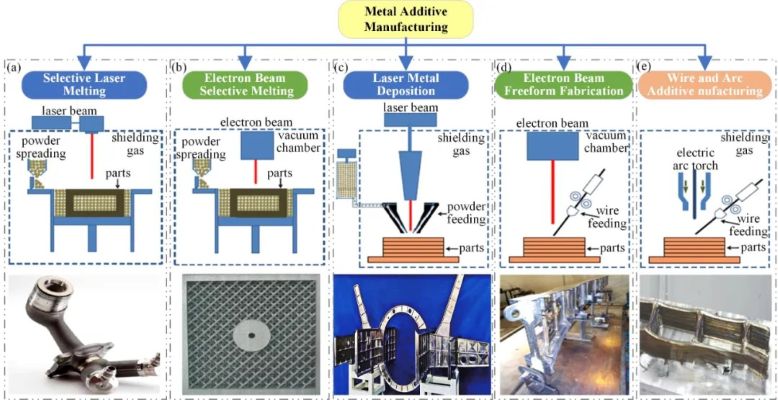
3. The Future of Metal AM-Driven Topology Optimization
The integration of material, structure, and process is driving four major trends in industrial design:
- Reduced Computational Burden: Combining TO with parallel computing avoids the need for manual CAD simplification after optimization, preserving 100% of the calculated structural performance.
- Multi-Scale Optimization: Blending macro-level topology with micro-level lattice structures allows engineers to maximize weight reduction while tailoring local stiffness.
- High-Fidelity Process Simulation: Future TO algorithms will move away from idealized material models, utilizing multi-parameter, real-time printing simulations to precisely forecast residual stress before the laser touches the powder.
- Multi-Material Topology: Optimizing Functionally Graded Materials (FGMs) will allow a single 3D-printed component to seamlessly shift from heat-resistant properties on one side to high-strength properties on the other.
Revolutionize Your Component Design with Advanced L-PBF Technology
Unlocking the full power of topology optimization requires an additive manufacturing system capable of handling highly complex geometries with extreme accuracy.
As a dedicated industrial metal 3D printer vendor, we offer cutting-edge Laser Powder Bed Fusion (L-PBF) systems alongside specialized engineering support to help you transform optimized digital concepts into high-performance aerospace realities.
Contact our technical team today to find the ideal metal 3D printing solution for your advanced engineering workflows.
Source: Liu Boyu, Wang Xiangming, Yang Guang, Xing Bendong. Research Progress on Topology Optimization Design for Metal Additive Manufacturing[J]. Chinese Journal of Lasers, 2023, 50(12): 1202301.