How Can You Improve Density in Metal 3D Printed Parts?
High Part Density Depends on a Stable Melting Process
You can improve density on an industrial metal 3D printer by balancing volumetric energy density, maintaining sufficient melt track overlap, using spherical powder feedstock, and stabilizing chamber shielding gas. Achieving relative density above 99.7% ensures that printed alloys match or exceed the mechanical properties of cast or forged equivalents.
Unlike cosmetic surface smoothness that can be polished after production, structural density reflects bulk metallurgical continuity. Internal micro-voids reduce load-bearing cross-sections and lower fatigue life under dynamic operating stresses.
Optimize Laser Power and Scanning Speed on a Metal 3D Printer
Laser power and scan velocity define the rate of linear thermal energy transferred into the powder bed. Setting these parameters requires mapping a stable melt pool window rather than maximizing laser output.
- Linear Energy Coupling: Operating a metal 3D printer with high scan speeds and insufficient laser power causes incomplete melting, leaving unbonded powder between tracks.
- Keyhole Thresholds: Excessive laser power coupled with slow scan velocities overheats the molten pool. This intense flux vaporizes volatile elements, creating deep vapor cavities that collapse into spherical pores.
- Melt Pool Aspect Ratio: Maintaining a stable pool width-to-depth ratio (typically $1.5:1$ to $2:1$) prevents convective turbulence from trapping process byproducts.
Harmonizing beam power and scan velocity establishes continuous liquid tracks free of spatter or balling.
Match Layer Thickness With the Printing Parameters
Layer thickness dictates the required vertical penetration depth of the molten pool. Slicing models on metal 3D printers requires matching slice height ($20\text{–}60\,\mu\text{m}$) directly to laser penetration.
When layers are sliced too thick, the beam fails to re-melt the upper boundary of the underlying solidified layer. This vertical gap causes widespread lack-of-fusion delamination across horizontal planes. Conversely, excessively thin slices increase cumulative thermal exposure. Overheating successive passes causes heat buildup, which promotes thermal distortion and raises total build time without delivering density gains.
Adjust Hatch Spacing for Better Material Coverage
Hatch spacing—the distance between adjacent parallel laser passes—controls lateral melt consolidation in metal 3D printing:
- Melt Track Overlap: Slicing algorithms must enforce a $30\%\text{–}50\%$ overlap between adjacent tracks to eliminate unmolten valleys between lines.
- Excessive Hatch Distance: Setting hatch spacing wider than the melt pool width leaves continuous lines of raw powder trapped inside the bulk core.
- Excessive Hatch Overlap: Tight hatch spacing re-melts previously solidified metal repeatedly. This excess heat builds raised edges and humping, which can collide with the recoater blade.
Calibrating hatch spacing against true melt pool width ensures uniform lateral fusion.
Powder Quality Supports Consistent Part Density
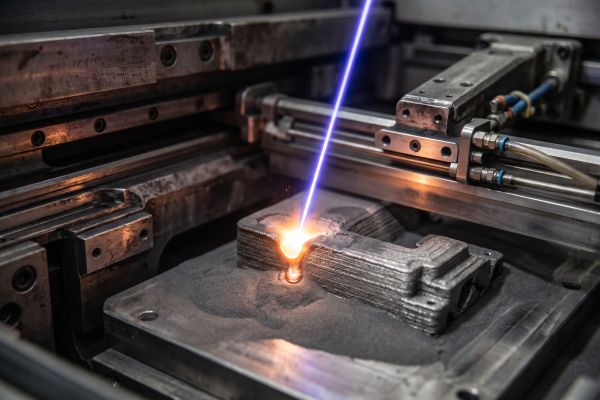
Powder characteristics determine how densely particles pack before the laser exposure cycle begins. Fluid, uniform powder beds promote stable liquid consolidation across every layer:
- Spherical Morphology: Gas- or plasma-atomized powders flow smoothly across the platform, preventing micro-voids caused by uneven powder spreading.
- Controlled Particle Size Distribution: Blending standard fractions ($15\text{–}53\,\mu\text{m}$) allows fine grains to fill interstices between larger spheres, raising apparent bed density.
- Moisture and Oxide Mitigation: Storing powder in dry, heated hoppers stops moisture from dissociating into hydrogen gas during melting.
Using clean, spherical powder prevents voids from entering the melt pool from the feedstock.
Maintain a Stable Printing Environment
Consolidating dense alloys requires maintaining an ultra-clean processing atmosphere per ISO/ASTM 52900 standard terms. A production metal 3D printer relies on uniform inerting to protect molten pools:
- Strict Oxygen Suppression: Oxygen levels must remain below $100\,\text{ppm}$ to prevent liquid pool oxidation. Surface oxide films disrupt liquid wetting and trigger inter-track porosity.
- Laminar Gas Velocity: Argon gas must sweep across the bed at uniform speeds ($1.5\text{–}2.5\,\text{m/s}$). Steady flow removes metallic soot and vapor condensate before they can settle into the beam path.
- Substrate Preheating: Maintaining elevated platform temperatures ($>150\text{–}200^\circ\text{C}$) reduces thermal gradients, minimizing cooling cracks in crack-sensitive tool steels.
A stable chamber atmosphere ensures predictable laser absorption from the first layer to final platform release.
Verify Density Through Standardized Testing
Validating metallurgical integrity requires quantitative testing rather than visual surface inspection:
- Archimedes Density Testing: Measures fluid displacement against dry mass, providing a rapid calculation of overall bulk density percentages.
- Optical Metallography: Sectioning, polishing, and etching sample coupons reveals the exact geometry, distribution, and root cause of internal voids.
- X-Ray Computed Tomography: 3D CT scanning provides non-destructive inspection of internal fluid channels and lattice networks, pinpointing microscopic porosity.
Combining these evaluation tools provides verifiable quality assurance across production builds on commercial metal 3D printers.
Achieving Maximum Density Across Metal 3D Printing Production
Consistently high density in metal 3D printing is the direct result of coordinated process control. Laser power, scan velocity, layer thickness, hatch spacing, powder morphology, and atmospheric purity must work together as a unified system. Focusing on any single parameter while neglecting powder quality or gas flow leads to recurring internal defects.
Achieving near-full density ($>99.7\%$) requires qualifying a balanced processing window tailored to your target alloy and part geometry. To evaluate material compatibility, qualify parameter sets, or review production capabilities for your next metal 3D printer, contact our technical engineering team today to review your component specifications.