How Does Build Chamber Size Affect Metal 3D Printing?
Build Chamber Size Affects More Than Part Dimensions
In metal 3D printing, build chamber size directly dictates internal thermal gradients, laminar gas velocity, and manufacturing flexibility, reaching far beyond the maximum printable bounding box. The build chamber represents the fully sealed, inert atmospheric housing per ISO/ASTM 52900 standard terms. In contrast, build volume refers strictly to the usable substrate envelope ($X \times Y \times Z$).
Chamber volume governs how shielding gas circulates. It controls how radiant heat dissipates across the powder bed. It also dictates how stable the optical beam path remains throughout continuous production cycles.
Larger Chambers Support Larger and More Complex Parts
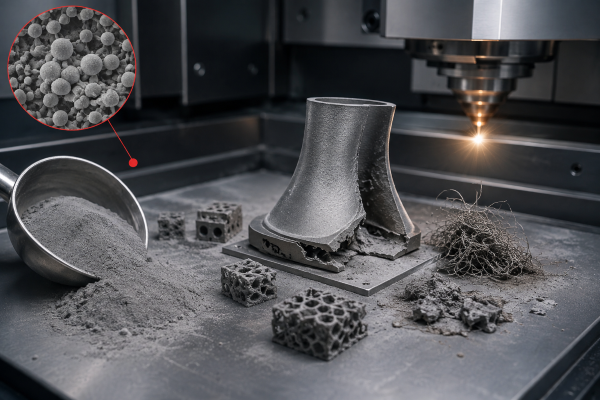
Expanding chamber boundaries allows aerospace and energy manufacturers to consolidate multi-piece assemblies into single monolithic structures. Massive rocket nozzles, heat exchangers, and structural aerospace frames exceed standard machine boundaries.
Complex geometries also demand generous internal envelope allowances. Angled orientations ($30^\circ\text{–}45^\circ$) require substantial Z-height clearances. This extra space prevents recoater blade collisions. Expanded space allows engineers to design robust sacrificial anchors. These anchors manage heavy residual stress without clipping chamber walls.
Chamber Size Influences Thermal Management
Internal volume directly alters thermal dynamics in metal 3D printing. Every exposure cycle inputs intense heat into localized powder zones. Meanwhile, the rest of the build plate radiates heat outward.
- Substrate Preheating: Maintaining uniform bed temperatures ($>200^\circ\text{C}$) over an expansive substrate requires zoned heating arrays to eliminate cold peripheral edges.
- Atmospheric Equilibrium: A massive metal 3D printer chamber contains more gas volume. This volume slows ambient heat spikes but requires careful convective balance.
- Thermal Stress Stabilization: Non-uniform cooling causes thermal contraction across wide build plates. This imbalance triggers substrate warping and layer separation.
Stable chamber insulation ensures that alloy cooling rates remain uniform from the first layer to final platform release.
Gas Flow and Oxygen Control Become More Important
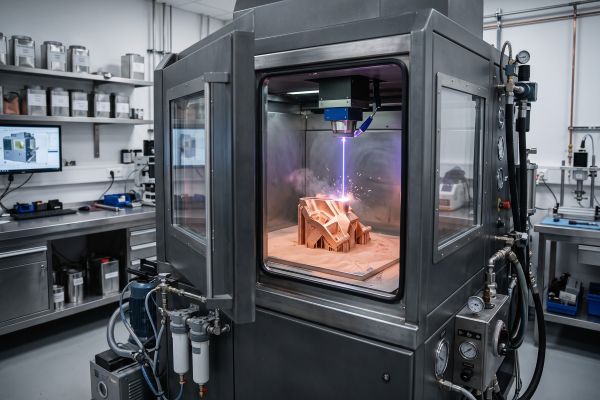
Laser-powder melting releases heavy condensation, metallic soot, and spatters. Purging a large metal 3D printer requires sweeping high-purity argon across extended build widths. It also demands strict inert atmosphere control ($<100\,\text{ppm}\,\text{O}_2$).
If gas velocity drops across wide distances, airborne soot settles onto un-sintered powder. This smoke scatters laser light and degrades beam energy. The resulting energy loss creates Lack-of-Fusion defects. Large chambers demand multi-channel laminar manifolds to evacuate process emissions without generating turbulent dead zones.
Larger Chambers Can Increase Production Flexibility
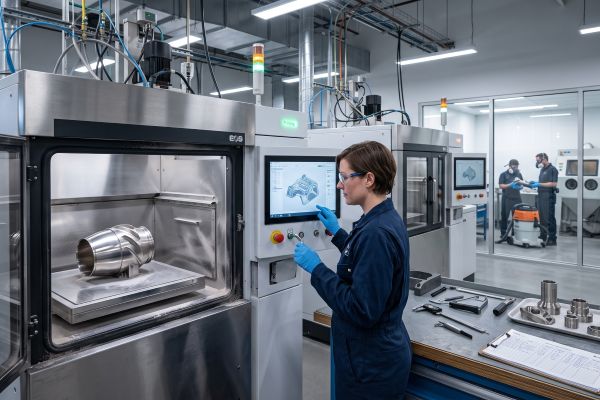
Generous envelope dimensions provide operational versatility when managing mixed-volume production schedules. Instead of processing a single massive component, industrial metal 3D printers can nest dozens of varied geometries onto one build plate.
Maximizing 2D and 3D nesting density amortizes non-productive cycle times. It spreads the cost of argon inerting, substrate preheating, and recoater travel across dozens of finished units. This approach increases overall equipment productivity. It also reduces manual setup intervals between production builds.
Is a Larger Build Chamber Always Better?
Larger processing chambers do not guarantee higher manufacturing efficiency. Sizing an industrial metal 3D printer too large creates substantial operational overhead:
- Inert Gas Consumption: Purging a $500 \times 500\,\text{mm}$ chamber consumes significantly more argon per build than a compact setup.
- Floor Space and Utilities: Large machines require heavy foundations, high-power electrical drops, and broader safety clearances.
- Powder Inventory Costs: Filling a deep piston requires substantial capital locked in high-cost alloy powders.
If daily production consists primarily of compact brackets or dental crowns, oversized chambers inflate unit production expenses without delivering practical utility.
Aligning Chamber Dimensions With Production Reliability
Chamber selection represents a direct trade-off between geometric capability and process control overhead. While larger volumes provide structural consolidation and batch nesting capacity, they demand precise thermal insulation and complex multi-zone gas extraction.
Engineering teams must calculate total system operating costs rather than chamber volume alone. The ideal build chamber stabilizes internal argon flow and maintains uniform thermal gradients across every production layer. Contact our engineering team today to evaluate how chamber dynamics influence your target alloy properties.