Can L-PBF 3D Printed Ti-6Al-4V Outperform Conventional Forgings in Aerospace Repairs?
Additive manufacturing (AM) is revolutionizing the aerospace MRO (Maintenance, Repair, and Overhaul) sector. However, a critical question remains for engineers and decision-makers: Can 3D-printed metal parts truly match or exceed the performance standards of traditional forged materials?
To bridge this gap, a landmark study conducted by Nanyang Technological University (NTU), the NTU-Rolls-Royce Corporate Lab, and Rolls-Royce Singapore was published in the International Journal of Fatigue. The research benchmarks Laser Powder Bed Fusion (L-PBF) against traditional forging for Ti-6Al-4V aerospace components.
The breakthrough findings reveal that with the right post-processing, 3D-printed titanium can actually deliver superior fatigue life compared to forgings. Here is a deep dive into how this is achieved and what it means for the future of industrial manufacturing.
The Core Challenge: Surface Finish vs. Residual Stress
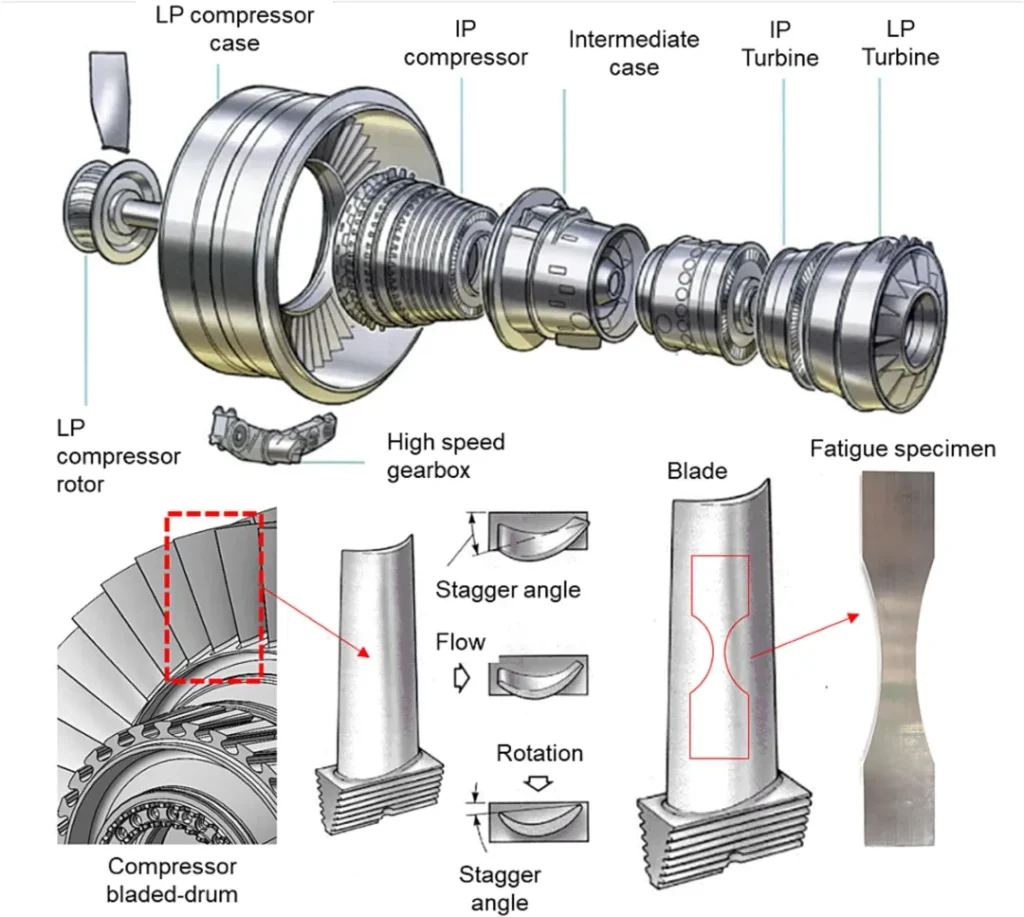
In the aerospace industry, components like turbine blades and blisks operate under extreme thermal and cyclic loads. These conditions make them highly susceptible to fatigue, creep, and corrosion. While surface polishing can improve fatigue life by up to 50%, choosing the right manufacturing sequence is a massive challenge.
Standard machining processes that induce beneficial compressive residual stress often degrade surface texture. Conversely, techniques that smooth the surface may eliminate that necessary stress.
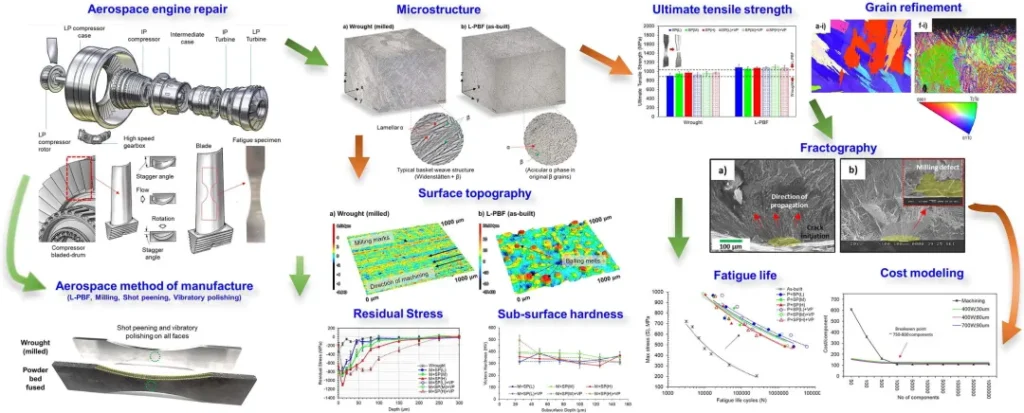
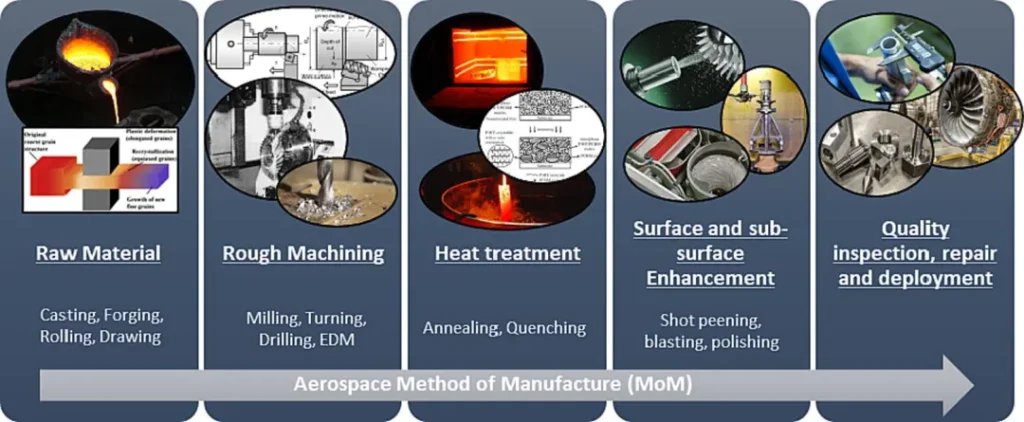
To solve this, the aerospace industry utilizes a strict Method of Manufacturing (MoM)—a precise sequence of heat treatment, fine milling, shot peening, and vibratory polishing.
The Aerospace MoM Breakthrough: Shot Peening + Vibratory Polishing
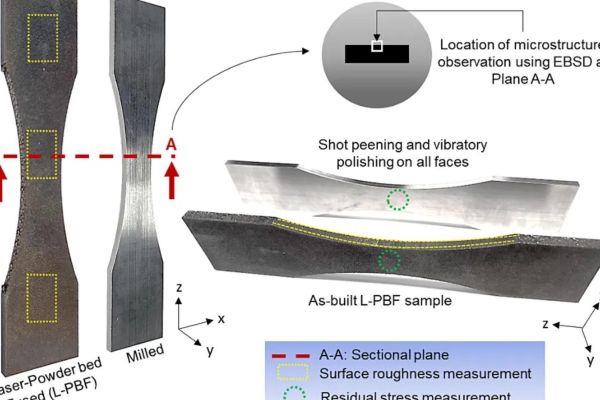
The research team tested the aerospace MoM sequence on both forged and L-PBF Ti-6Al-4V specimens to evaluate their subsurface properties, roughness, and microhardness.
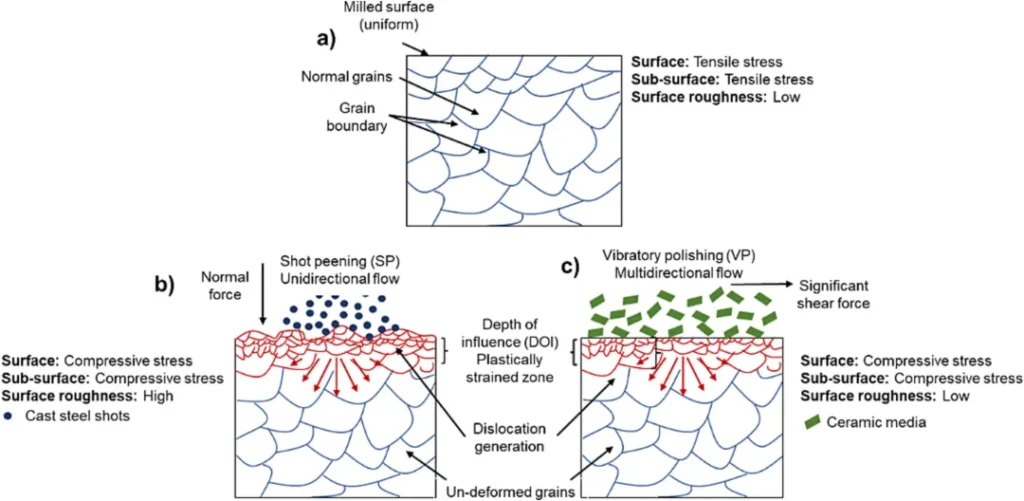
- Milling: Creates a low-roughness surface but can leave harmful tensile stresses and subsurface microcracks.
- Shot Peening: Plastically deforms the material, refining the grain structure and introducing vital compressive residual stress (CRS). However, it drastically increases surface roughness ($Ra$ up to 1.50 µm).
- Vibratory Polishing: This final step acts as the game-changer. The study proved that a 165-minute vibratory polishing cycle uniformly smooths the surface back to a pristine $Ra$ of $0.25 \pm 0.05$ µm while perfectly preserving the beneficial compressive stress and grain refinement injected by shot peening.
Head-to-Head: L-PBF 3D Printing vs. Forging Results
The mechanical testing yielded groundbreaking data for industrial 3D printing adoption:
1. 15% Higher Tensile Strength (UTS)
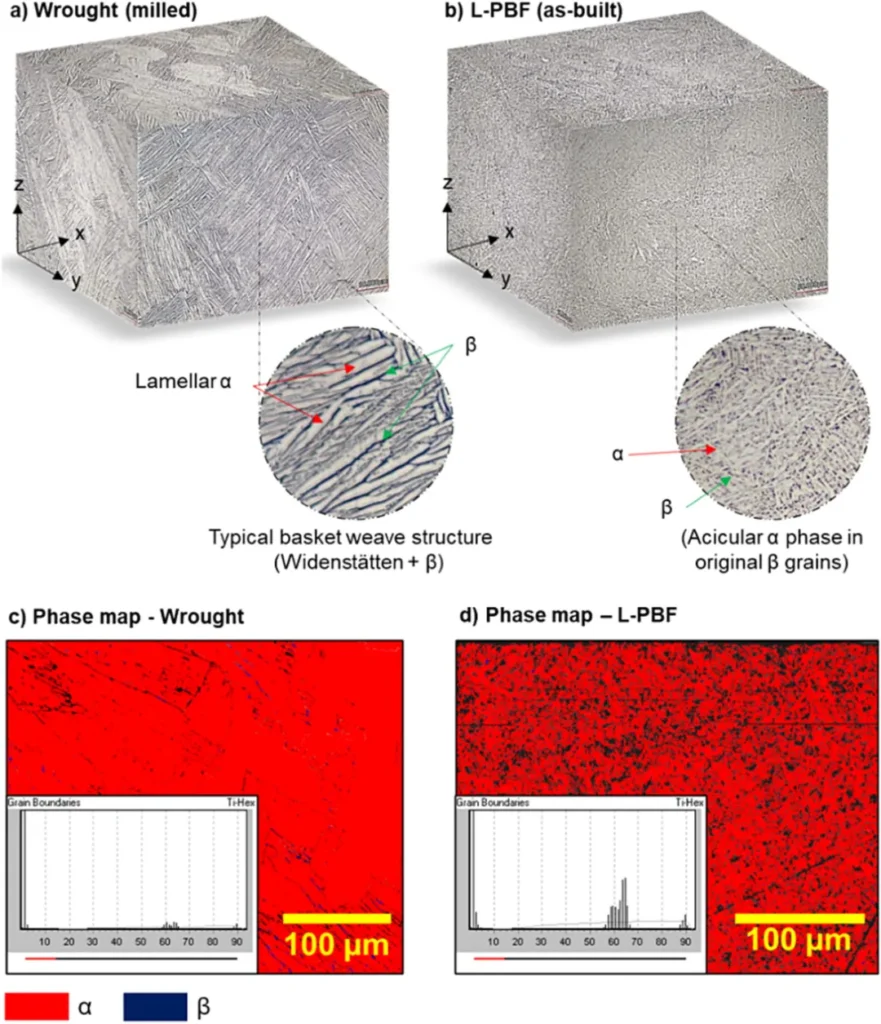
Thanks to the fine acicular $\alpha$ and $\beta$ phase microstructures formed during post-printing heat treatment, the L-PBF specimens achieved an Ultimate Tensile Strength (UTS) of 1033 MPa—approximately 15% higher than the forged Ti-6Al-4V (888 MPa).
2. Superior Fatigue Life
When subjected to rigorous axial loading simulating aircraft engine cruise conditions, the MoM-treated L-PBF specimens outperformed their forged counterparts, achieving a maximum lifecycle of $5.5 \times 10^6$ cycles. While untreated “as-built” 3D printed parts showed poor fatigue behavior due to surface defects, the combination of shot peening and vibratory polishing completely unlocked the material’s potential.
Economic Viability: When to Choose 3D Printing over Forging?
Beyond mechanical performance, the study evaluated lifecycle cost models for aerospace repairs, providing a clear roadmap for manufacturers:
- Small-Scale Repairs (Low Volume): L-PBF 3D printing is exceptionally cost-effective. It eliminates expensive tooling costs and significantly reduces lead times while offering superior fatigue life.
- Large-Scale Repairs (High Volume): Conventional forged materials remain more economical due to economies of scale, though they may compromise on the maximum achievable fatigue life compared to optimized L-PBF parts.
Unlocking Industrial Metal 3D Printing
This study proves that L-PBF additive manufacturing is no longer just a prototyping tool. It is a fully viable, high-performance alternative to forging for mission-critical aerospace components, provided that proper MoM post-processing is applied.
By integrating advanced post-processing like shot peening and vibratory polishing, industrial manufacturers can confidently deploy 3D-printed titanium parts that are stronger, longer-lasting, and highly cost-effective for targeted repair applications.
Optimize Your Metal Manufacturing Workflow Today
Are you looking to implement high-performance metal 3D printing into your production line? As a leading industrial 3D printer vendor, we provide end-to-end solutions from advanced L-PBF systems to expert post-processing guidance.
Contact our application engineers today to get a free consultation on how to upgrade your manufacturing capabilities with titanium 3D printing.
Paper Reference: “Comparative fatigue analysis of conventional and laser powder bed fused Ti-6Al-4V for aerospace repairs: Academic and Industrial insights”, International Journal of Fatigue (2023).
Paper link: https://doi.org/10.1016/j.ijfatigue.2023.107879