What Causes Porosity in Metal 3D Printed Parts?
Porosity Is a Common Internal Defect in Metal 3D Printed Parts
Porosity in metal 3D printing is caused by insufficient energy input, unstable melt pool vapor depressions, hollow powder feedstock, or contaminated atmospheric shielding during laser melting. Porosity refers to micro-voids and entrapped pockets distributed throughout a solidified component matrix.
Unlike surface roughness or dimensional warping that can be corrected by secondary machining, internal pores act as stress concentrators. These subsurface voids reduce dynamic fatigue resistance and can trigger brittle fracture under cyclic loads.
Lack of Fusion Can Create Irregular Internal Voids
Lack of fusion (LoF) occurs when localized thermal energy fails to penetrate fully into the underlying solidified substrate or adjacent melt tracks. These defects exhibit jagged, elongated shapes often packed with loose, unmolten powder particles.
- Insufficient Energy Penetration: Low laser power combined with excessive scan speeds prevents melt pools from overlapping properly.
- Mismatched Track Spacing: If hatch spacing is set wider than the physical melt pool width, narrow gaps remain between adjacent exposure lines.
- Layer Height Boundaries: Slicing models with excessive layer thicknesses prevents energy from re-melting the previous layer, forming planar delamination cracks.
Industrial metal 3D printers eliminate LoF defects by adjusting scan patterns and maintaining adequate track overlap.
Gas Entrapment Can Form Spherical Pores
Spherical gas porosity forms through fluid trapping rather than incomplete melting. These voids are typically smooth, circular, and scattered throughout the consolidated matrix.
- Feedstock Gas Retention: Hollow powder particles produced during gas atomization carry pockets of trapped argon or nitrogen. As the laser liquefies the powder, these gas bubbles enter the melt pool and remain trapped during rapid freezing.
- Keyhole Instability: Excessive laser intensity vaporizes volatile alloying elements, drilling a deep vapor depression into the substrate. If this depression becomes unstable, keyhole collapse pinches off vapor pockets at the root of the melt track.
- Marangoni Convection: Intense surface-tension gradients drive rapid fluid circulation inside the molten pool. These convective currents drag dissolved ambient gas downward before bubbles can buoyantly escape the liquid surface.
Managing laser power intensity and using plasma-atomized powder lots significantly reduces spherical gas voids.
Printing Parameters in Metal 3D Printing Drive Void Formation
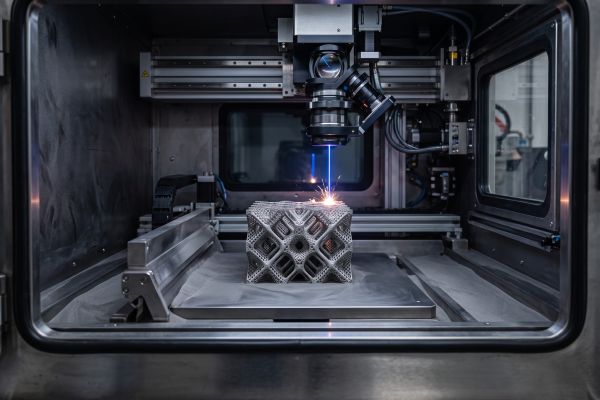
Void formation correlates directly with how energy couples into the powder bed. Process engineers calculate volumetric energy density (VED) to define the stable processing window:
$$\text{VED} = \frac{P}{v \cdot h \cdot t}$$
A production metal 3D printer operating below the critical VED threshold generates lack-of-fusion voids. Conversely, driving excessive power into narrow melt tracks causes boiling and spatter. Achieving dense consolidation requires balancing laser power ($P$), scan velocity ($v$), hatch spacing ($h$), and slice thickness ($t$) concurrently rather than changing parameters in isolation.
Powder Quality and Handling Can Affect Internal Defects
Powder feedstock quality directly dictates the metallurgical cleanliness of consolidated parts. Inconsistent powder packing densities increase the likelihood of void formation:
- Satellite Particles: Irregular powder grain morphology hinders smooth recoating, creating localized powder starvation zones across the bed.
- Moisture and Oxidation: Humid storage conditions introduce surface moisture onto reactive titanium or aluminum alloys. During laser exposure, hydrogen disassociates from water vapor, creating fine hydrogen gas pores.
- Powder Aging: Reusing powder across multiple production runs on commercial metal 3D printers increases satellite agglomeration and pick-up of oxide inclusions.
Sieving and desiccating powder lots helps maintain dense packing under the recoater blade.
How Inert Gas and Oxygen Levels Affect Porosity
Atmospheric stability inside the build chamber protects the liquid melt pool from chemical contamination. Operating a metal 3D printer with erratic gas flow increases porosity through several mechanisms:
- Soot and Condensate Attenuation: Laser melting produces plumes of metal vapor and nano-soot. Sluggish gas flow lets this smoke hang over the scan track, attenuating beam energy before it strikes the powder.
- Oxide Film Formation: Oxygen levels above $100\,\text{ppm}$ oxidize liquid alloy surfaces. These oxide skins alter molten surface tension, disrupting liquid wetting and promoting inter-track voids.
- Spatter Re-deposition: Turbulent gas streams can drop heavy spatter particles back into the active exposure path, preventing clean subsequent layer fusion.
Maintaining laminar gas flow ensures process byproducts are evacuated continuously.
How Can Porosity Be Detected and Reduced?
Verifying internal structural integrity requires rigorous non-destructive and destructive testing routines per the ISO/ASTM 52900 classification:
- Archimedes Density Testing: Measures fluid displacement to calculate overall bulk density percentages rapidly.
- High-Resolution Industrial CT: 3D X-ray tomography maps the spatial distribution, sphericity, and volume percentage of micro-voids throughout closed internal cavities.
- Cross-Sectional Metallography: Polished and etched coupon cross-sections reveal whether voids stem from sharp LoF tears or round gas bubbles.
Controlling internal porosity requires balancing thermal input, preserving powder cleanliness, and maintaining stable gas recirculation across every layer.
Controlling Porosity for Reliable Metal 3D Printing Production
Internal porosity is not an inevitable defect in metal 3D printing, but the direct consequence of mismatched thermal energy, unstable melt dynamics, or compromised powder feedstock. While jagged lack-of-fusion voids signal energy deficits, spherical gas pores reveal overheating or contaminated raw materials.
Achieving structural density above 99.7% demands a holistic approach: harmonizing laser exposure vectors, maintaining dry spherical powders, and ensuring clean laminar shielding gas across the build chamber. Operating a qualified metal 3D printer with verified parameter sets ensures components deliver full structural integrity under demanding industrial loads. Contact our metallurgists today to review your cross-sectional CT reports and develop optimized parameter sets for your critical alloy parts.