What Build Size Do You Need in a Metal 3D Printer?
Build Size Determines What You Can Produce
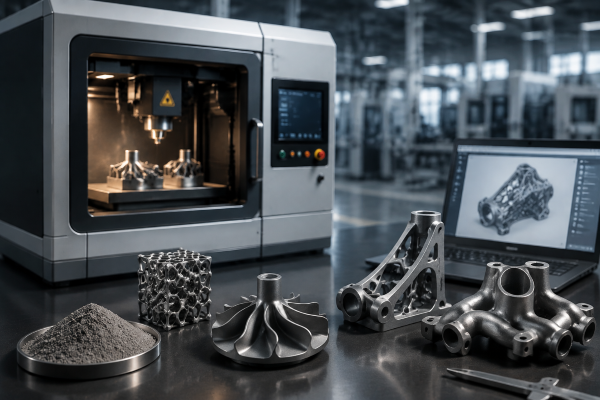
You need a metal 3D printer build size that accommodates 80% to 90% of your daily component mix rather than your single largest theoretical part. The usable build envelope dictates the maximum physical dimensions of printable geometry, but buying exclusively for rare extreme part sizes leads to chronic machine underutilization, excessive shielding gas consumption, and inflated operational costs. Selecting appropriate dimensions requires balancing recurring part geometry against industrial metal 3D printing process physics and unit economics.
- Envelope Utilization: Choose chamber bounds where standard production batches occupy $>70\%$ of plate surface area.
- Economic Footprint: Avoid paying oversized inerting and heating overhead for occasionally manufactured large geometries.
- Process Feasibility: Match component dimensions to recoater blade clearance and support generation limits.
Match Build Volume to Your Typical Parts
Manufacturing facilities categorize industrial components into distinct envelope classifications based on industry applications:
| Machine Category | Typical Build Volume (X×Y×Z) | Primary Industrial Applications | Ideal Production Mode |
| Small-Format | $\le 150 \times 150 \times 150\,\text{mm}$ | Dental crowns, medical implants, jewelry, lab R&D | Fast-turnaround prototyping |
| Medium-Format | $250 \times 250 \times 350\,\text{mm}$ | Conformal cooling mold inserts, brackets, pump impellers | Versatile small-to-mid series |
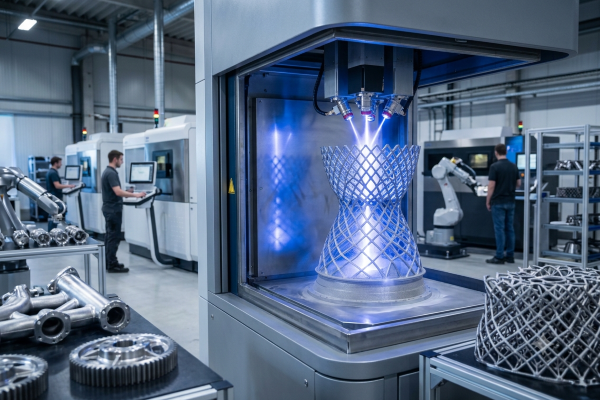
| Large-Format | $\ge 400 \times 400 \times 500\,\text{mm}$ | Rocket combustion chambers, turbine exhaust rings | Dedicated continuous serial runs |
Procurement teams should avoid sizing a metal 3D printer for a single legacy component. If outsized parts represent under $10\%$ of total production volume, outsourcing them to third-party contract bureaus is far more cost-effective than absorbing the ongoing operational overhead of large-format metal 3D printers.
Larger Build Size Does Not Always Mean Better Performance
Scaling the build envelope introduces technical complexity. A larger chamber requires significantly more inert gas to achieve safe oxygen thresholds ($<100\,\text{ppm}$) before melting begins.
Thermal management becomes increasingly demanding over larger surfaces. Maintaining uniform substrate heating ($>200^\circ\text{C}$) across wide plates requires complex multi-zone heaters to eliminate edge-cooling temperature gradients. Furthermore, multi-laser metal 3D printing across broad fields requires advanced dynamic focusing optics and laminar gas flow designs to prevent optical distortion and soot buildup. These hardware requirements inflate facility floor space requirements, foundational load ratings, and utility operating costs.
Consider Part Orientation and Nesting
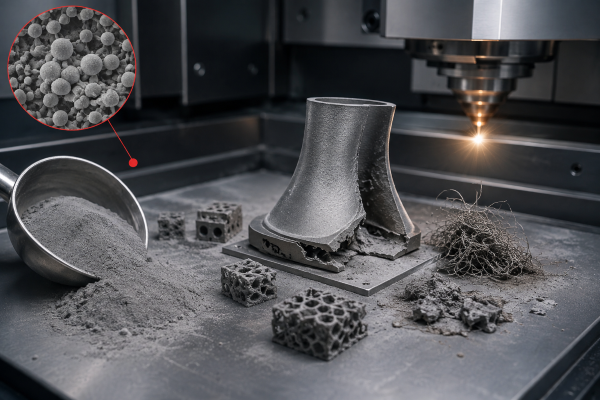
Nominal bounding boxes rarely reflect actual space requirements. Metal components frequently require inclined build angles ($30^\circ\text{–}45^\circ$) per ISO/ASTM 52911-1 design guidelines to minimize cross-sectional recoater stresses and reduce support volume.
- Z-Axis Height Impact: Tilting a long, slender bracket multiplies vertical Z-height, extending overall recoating cycles.
- Horizontal Stacking: Medium chambers allow dense 2D packing of identical flanges or dental copings on a single substrate.
- Vertical Nesting: Tall vertical envelopes accommodate stacked components, multiplying parts per cycle using laser powder bed fusion technology.
Evaluating actual nesting density—rather than raw flat placement—reveals the true build volume necessary to hit required batch yields.
How Build Size Affects Production Efficiency
Equipment volume dictates batch cycle workflows. Large-format metal 3D printers excel at mass-producing hundreds of small fasteners or multiple turbine nozzles in a single, uninterrupted 100-hour production run. This workflow drastically cuts downtime between setup, platform leveling, and plate depowdering.
Conversely, high-mix job shops gain agility with a compact metal 3D printer. Smaller chambers purge in under 15 minutes, consume minimal powder inventory, and accommodate swift alloy changeovers between titanium, stainless steel, and nickel superalloys without lengthy cleaning rituals.
Choose Build Size Based on Your Future Production Needs
Select your equipment by mapping production volume growth over a 3- to 5-year investment window. Assess anticipated engineering shifts, such as assembling modular multi-piece designs into single consolidated lightweight components.
The right metal 3D printer provides the highest nesting density at the lowest operating cost per batch, giving your facility reliable production stability without carrying unused build volume overhead. Contact our application team to benchmark your production CAD files and determine the optimal machine footprint.