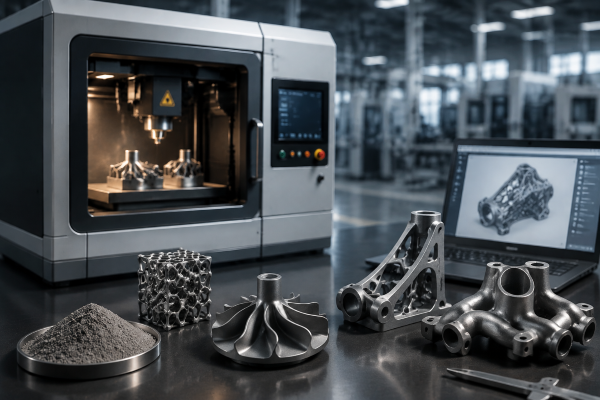
Is Supportless Metal 3D Printing Actually Feasible for Production?
Supportless metal 3D printing has quickly moved from lab research to real factory floors. Many machine makers promise complete design freedom. At the same time, factory engineers still worry about rough downskins, blade crashes, and part warpage.
Can support-free metal 3D printing actually handle volume production today? The direct answer is yes. However, teams must understand the physical limits and use the right machine configurations.
This guide breaks down the real limits, failure causes, enabling technologies, and manufacturing costs of low-angle metal 3D printing.
Quick Answer: The True Limits of Supportless Metal 3D Printing
Direct Answer
Modern metal 3D printing systems can build overhangs down to 20°–30° without internal supports. They can also reliably print horizontal holes up to $\varnothing 100\,\text{mm}$.
However, flat horizontal surfaces ($0^\circ$) still follow basic thermal rules. Large flat roofs require non-contact heat sinks or special toolpaths to pull heat away and prevent heavy dross.
Capability Matrix: Angles, Surface Quality, and Alloys
| Overhang Angle | Expected Roughness (Ra) | Production Status | Recommended Alloys |
| $\ge 45^\circ$ | $6 – 9\,\mu\text{m}$ | Standard baseline across all machines | Ti-6Al-4V, IN718, 316L, AlSi10Mg |
| $20^\circ – 45^\circ$ | $10 – 16\,\mu\text{m}$ | Proven with dynamic energy control | IN718, Hastelloy X, Ti-6Al-4V |
| $10^\circ – 20^\circ$ | $15 – 25\,\mu\text{m}$ | High yield on soft-recoater setups | Inconel 718, CoCr, Tool Steels |
| $0^\circ$ (Flat Roof / $<10^\circ$) | $>25\,\mu\text{m}$ (Downskin) | Feasible up to $15\,\text{mm}$ with heat sinks | Nickel superalloys, Tool steels |
Why Traditional SLM Demands Heavy Support Structures
To see how new systems remove supports, we must look at why standard metal 3D printing needed them in the first place.
Powder Thermal Insulation and Overheating
Solid metal conducts heat well. For example, solid Inconel 718 conducts heat at around $11.4\,\text{W/m}\cdot\text{K}$. Loose metal powder is very different. It traps heat, with thermal conductivity between only $0.15$ and $0.25\,\text{W/m}\cdot\text{K}$.
When a standard laser scans over loose powder, heat cannot escape downward:
- Heat Trapping: Thermal energy builds up quickly in the melt zone.
- Melt Pool Growth: The liquid melt pool grows too large and sinks into the loose powder below.
- Rough Dross: As it cools, the metal forms rough bumps and hanging dross.
Traditional metal additive manufacturing uses thick supports mainly as heat pipes to draw this energy down to the build plate.
Residual Stress and Recoater Blade Collisions
Laser printing involves steep temperature changes and very fast cooling. As molten tracks cool down, they shrink. This shrinkage creates high tensile stress at unsupported edges:
- Upward Edge Curl: Without anchors, thin overhang edges curl upward toward the laser.
- Hard Blade Impacts: Standard machines use stiff ceramic or high-speed steel blades. These rigid blades hit the curled metal edges during powder recoating.
- Costly Failures: These impacts break recoater blades, streak the powder bed, and ruin entire builds. Heavy supports were the only way to hold edges down.
Core Technologies Enabling Low-Angle Metal 3D Printing
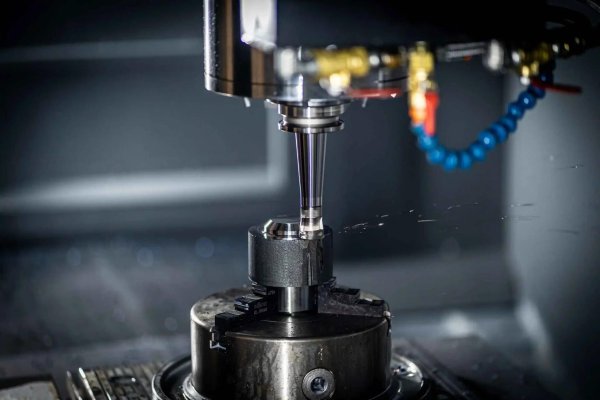
Modern industrial machines eliminate solid anchors by solving thermal buildup and blade contact with three core innovations.
Downskin Power Modulation & Dynamic Pulse Control
Support-free builds start with smart energy control in slicing software. The software identifies downskins, overhang borders, and core zones automatically:
- Lower Energy Input: The system cuts laser power by 40% to 60% over overhang zones. This lowers the Volumetric Energy Density ($VED = \frac{P}{v \cdot h \cdot t}$).
- No Melt Sag: Keeping the melt pool thin stops liquid metal from sinking into loose powder. This keeps downskin surfaces clean in advanced metal 3D printing.
- Short Laser Pulses: Fast pulsed laser firing replaces continuous beams. This keeps the melt pool shallow ($30 – 60\,\mu\text{m}$).
Contact-Free Heat-Sink Toolpathing
For very low angles between $0^\circ$ and $15^\circ$, smart slicing tools create non-contact cooling structures right below the part:
- Small Powder Gap: The system builds cooling fins separated from the part by a $50 – 120\,\mu\text{m}$ powder gap.
- Radiant Cooling: Heat jumps across this tiny gap into the cooling fin without welding the two parts together.
- Zero Cutting Labor: After the build, the part lifts out during normal powder cleaning. Operators do not need wire EDM or chisels to clean the surfaces.
Compliant and Soft Recoater Systems
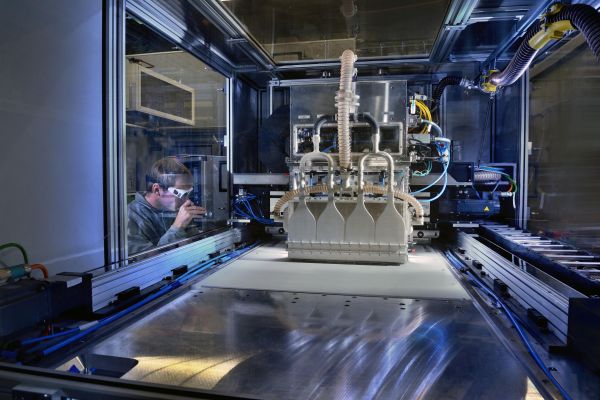
Better machine hardware stops recoater crashes for good. Rigid blades cannot handle small part movements. Compliant recoaters use flexible silicone, carbon fiber edges, or durable brushes instead:
- Bending Over Bumps: When passing over slight edge curl ($10 – 30\,\mu\text{m}$), the soft blade flexes over the metal without jamming.
- Smooth Powder Layers: The blade spreads the next powder layer evenly without dragging or digging into the bed.
- High Machine Uptime: Removing blade crashes makes automated, multi-day metal 3D printing reliable for tough geometries.
Industrial ROI Assessment: Support Removal vs. Machine Investment
Switching to low-angle direct metal printing changes shop-floor economics. New software and hardware require upfront capital, but cutting post-processing steps pays back fast on complex components.
In typical workflows, machine time and powder make up about 45% of total part cost. Wire EDM, machining, and hand deburring take up the other 55%. With support-free parameter sets, machine time rises to roughly 58% of costs, but post-processing drops below 42%. This cuts total part costs by 25% to 35% on enclosed parts.
Closed Impellers and Turbomachinery
Closed impellers have narrow, twisted internal flow channels. Manual tools simply cannot reach inside them to remove supports:
- Traditional Method: Shops print impellers in two pieces, mill out the internal supports, and weld the pieces back together. This adds tooling costs, lead time, and joint failure risks.
- Supportless Method: Monolithic metal 3D printing down to $20^\circ$ vane angles needs no internal supports at all. Post-processing requires only powder removal, heat treatment, and CNC turning of mating faces. This cuts delivery times by 65%.
High-Efficiency Heat Exchangers & Manifolds
Compact fluid manifolds and gyroid (TPMS) heat exchangers cannot have leftover support burrs inside. Loose burrs block flow paths and create high pressure drops:
- Clean Internal Channels: Building horizontal channels up to $\varnothing 100\,\text{mm}$ without supports eliminates chemical etching and EDM slicing.
- Lower Labor Costs: On nickel superalloy and titanium components, post-processing labor drops by more than 40%. This quick saving pays off machine upgrades within the first year of production.
Conclusion & Next Steps
Supportless metal 3D printing is ready for industrial production within clear physical limits. Overhangs down to 20° and internal channels up to $\varnothing 100\,\text{mm}$ run with high yield today. Large flat horizontal surfaces still require dedicated thermal strategies. By using adaptive laser energy and flexible recoaters, manufacturers can eliminate the manual deburring and wire EDM steps that slow down production.
Ready to eliminate internal supports and streamline your production? Get in touch with our engineering team today to discuss your project requirements and see how we can help.