Why Multi-Laser Metal 3D Printing Causes Overlap Defects
Quick Answer: Root Causes and Solutions (BLUF)
Overlap defects in multi-laser metal 3D printing stem from galvanometer thermal drift, melt pool collision with keyholing, and cross-laser plume scattering along overlapping boundary lines. Eliminating these structural seam inconsistencies requires dynamic seam-weaving algorithms, in-chamber automated optical calibration, and multi-zone laminar gas flow designs.
- Relative Density: Advanced systems achieve overlap zone density of $\ge 99.9\%$, matching single-laser core material.
- Tensile Retention: Seam-weaving ensures cross-seam static tensile strength retention $>98\%$ without premature failure.
- Positioning Accuracy: Closed-loop optical calibration maintains multi-laser spot alignment within $\pm 15\,\mu\text{m}$.
The Physics of Overlap Seam Inconsistencies in Metal 3D Printing
Industrial laser powder bed fusion leverages multi-optical architectures to multiply productivity. However, physical interactions at overlapping exposure zones create unique microstructural boundaries.
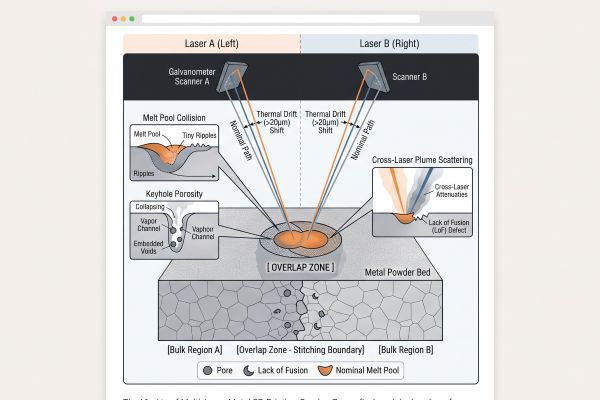
Galvo Thermal Drift
During continuous production runs exceeding 50 hours, high-speed galvanometer mirrors and drive motors accumulate substantial thermal energy. This continuous thermal load induces mechanical and optical drift of $20\text{–}50\,\mu\text{m}$ across the scanning field. In multi-beam metal 3D printing, this positional shift misaligns adjacent exposure zones, generating unexposed gaps or localized excessive overlap seams that compromise structural integrity.
Melt Pool Collision & Keyholing
Simultaneous exposure across overlap boundaries forces adjacent laser melt pools to interact constructively. The resulting concentrated energy density exceeds the metal alloy vaporization point, triggering intense recoil pressure. This rapid vaporization creates unstable keyhole depressions that collapse before molten material can backfill, leaving high-aspect-ratio gas pores along the seam boundary.
Cross-Laser Smoke & Plume Scattering
Laser-material interactions generate vapor plumes, fine condensates, and spatter emissions. When these emissions cross the beam path of an adjacent optical unit, they scatter the incoming energy and attenuate effective laser power by $15\text{–}30\%$. This localized energy drop creates severe Lack-of-Fusion (LoF) voids and unmolten powder inclusions along the seam line.
3 Engineering Solutions That Eliminate Stitching Defects
Eliminating boundary inconsistencies requires dedicated hardware controls and advanced exposure toolpaths to stabilize multi-laser metal 3D printing systems.
| Process Variable | Defect Mechanism | Engineering Countermeasure | Target Metric / Tolerance |
| Galvo Thermal Load | Positional Drift ($20\text{–}50\,\mu\text{m}$) | In-Chamber Automated Optical Calibration | Spot alignment $\le \pm 15\,\mu\text{m}$ |
| Simultaneous Exposure | Keyhole Pores & Recoil Collapse | Dynamic Seam-Weaving & Staggered Delay | Tensile retention $>98\%$ |
| Plume Cross-Over | Laser Attenuation & LoF Defects | Multi-Zone Laminar Gas Flow Field | Gas velocity variation $\le 10\%$ |
Dynamic Seam-Weaving & Staggered Exposure
Straight overlap seams form continuous planar weakness zones prone to delamination. Advanced pathing engines replace straight split lines with sinusoidal or stochastic interlocking wave boundaries ($2\text{–}4\,\text{mm}$ amplitude). Additionally, exposure sequences implement microsecond time delays between adjacent lasers. This offset allows the first melt track to solidify below its solidus temperature before the neighboring beam arrives, completely preventing melt pool collision and keyhole porosity.
In-Chamber Automated Optical Calibration
To counteract operational thermal shifts, modern additive equipment integrates machine vision and pre-installed reference targets directly inside the chamber:
- Automated Burn Grid Inspection: High-resolution cameras capture reference mark patterns exposed on dedicated calibration plates at designated layer intervals.
- Correction Matrix Calculation: Systems dynamically calculate optical field distortion matrices and update galvanometer look-up tables (LUT).
- High-Precision Realignment: Closed-loop alignment keeps spot overlap tolerance strictly within $\pm 15\,\mu\text{m}$ throughout full build cycles.
Multi-Zone Laminar Gas Flow
Single-direction gas flow systems allow upstream emissions to traverse downstream laser paths. Next-generation systems partition gas delivery into independent laminar flow channels equipped with precision micro-nozzle arrays. By maintaining uniform argon gas flow ($1.5\text{–}2.5\,\text{m/s}$ across sub-zones with $\le 10\%$ variation), spatters and vapor plumes evacuate instantly without entering adjacent optical paths.
Procurement Validation: Testing Multi-Laser Integrity During FAT
Factory Acceptance Testing (FAT) must rigorously evaluate stitch-line metallurgical integrity before commissioning any multi-laser metal 3D printing platform.
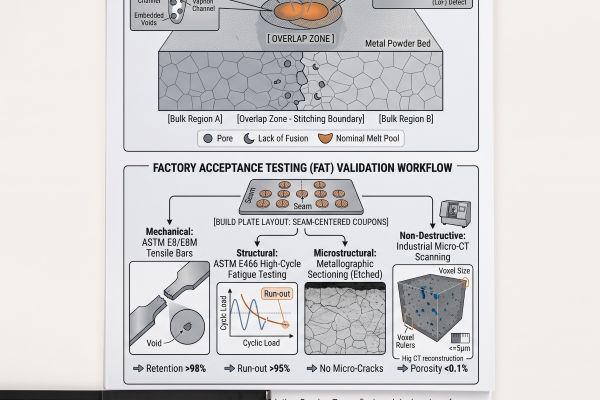
Cross-Seam Tensile & Fatigue Qualification
Procurement teams should arrange standard mechanical coupons across laser boundary splits, centering the seam within the test gage:
- Static Tensile Testing (ASTM E8/E8M): Overlap coupons must demonstrate ultimate tensile strength (UTS) and yield strength (YS) retention $>98\%$ compared to single-laser baseline specimens, with no premature necking at the stitch line.
- High-Cycle Fatigue Testing (ASTM E466): Conduct axial fatigue testing ($R = 0.1$, $f = 20\text{–}50\,\text{Hz}$). Overlap coupons must demonstrate fatigue endurance limits exceeding $95\%$ of monolithic baselines without seam-initiated cracking.
Micro-CT Scanning and Metallographic Inspection
Non-destructive evaluation and microscopic imaging confirm internal density across the stitch zone:
- Industrial Micro-CT: Perform volume reconstruction at voxel resolutions $\le 5\,\mu\text{m}$. The overlap zone must achieve overall porosity $\le 0.1\%$, with zero contiguous Lack-of-Fusion voids $>25\,\mu\text{m}$.
- Cross-Section Metallography: Etched cross-sections analyzed under SEM must confirm uniform grain transition and defect-free bonding across adjacent laser melt pools.
Conclusion & Technical Resource Access
Unlocking the full productivity of multi-beam metal 3D printing requires stabilizing boundary physics through dynamic seam-weaving, automated optical calibration, and zoned laminar gas control. Verifying these systems via ASTM mechanical testing and Micro-CT scanning during FAT guarantees consistent, production-grade material performance. across the entire build platform.